
Automating Application First Reads with Bolt Agents
What Is the Application First
Read Process?
In a well-run admissions office, the “First Read” is the rapid yet rigorous triage that turns a raw, completed application into a scored, annotated file ready for committee action.
Within days (or hours for some community colleges), trained readers use a shared rubric to gauge academic strength and personal factors, capture concise notes, and issue a preliminary admit/deny/hold recommendation.
Success is judged by swift turnaround, high agreement between multiple readers, strong alignment with final decisions, and preservation—or improvement—of applicant-pool diversity as files advance to the next review stage.

The Problem (Manual Process + Fraud)
Human first reads are manual, slow and inconsistent. Queues pile up, fraud slips through, and staff burn out. Applicants wait weeks for decisions and yield suffers.
Human readers are inefficient and often biased
◉ Backlogs create decision delays
◉ Inconsistent rubric application across readers
◉ Second reads and committee work add even more cycle time
Fraud is a nationwide drain on time and aid dollars
◉ 34% of all applications were fraudulent in California Community Colleges
◉ $13M reported losses in California alone; $100M+ across the U.S. (2024)
Old Way vs. Agentic Way
The Before and After of Application First Reads
 |  | |
|---|---|---|
| Intake | Apps land in an overflowing queue; readers pull in batches | Agents ingest files in real time and start work immediately |
| Fraud triage | Fraud is identified on an ad-hoc basis or after the fact | Bolt Fraud Detector flags high‑risk signals before review |
| First read | 15–30 minutes; quality varies | Bolt App Reader produces a first read score with rationale in minutes |
| Second read routing | Manual triage & assignment | Auto‑assignment based on rules |
| Decision support | Notes scattered; hard to compare | Structured scorecards & consistent rubric |
| Human role | Heavy on documentation reading and analysis | Focus on edge cases and final decisions |
| Intake | |
|---|---|
| Old Way (Manual) | Apps land in an overflowing queue; readers pull in batches |
| New Way (Agentic) | Agents ingest files in real time and start work immediately |
| Fraud triage | |
| Old Way (Manual) | Fraud is identified on an ad-hoc basis or after the fact |
| New Way (Agentic) | Bolt Fraud Detector flags high‑risk signals before review |
| First read | |
| Old Way (Manual) | 15–30 minutes; quality varies |
| New Way (Agentic) | Bolt App Reader produces a first read score with rationale in minutes |
| Second read routing | |
| Old Way (Manual) | Manual triage & assignment |
| New Way (Agentic) | Auto‑assignment based on rules |
| Decision support | |
| Old Way (Manual) | Notes scattered; hard to compare |
| New Way (Agentic) | Structured scorecards & consistent rubric |
| Human role | |
| Old Way (Manual) | Heavy on documentation reading and analysis |
| New Way (Agentic) | Focus on edge cases and final decisions |
The Solution (With Bolt Agents)
Bolt Agents bring an agentic, goals‑driven workflow to first reads. The Fraud Detector agent triages risk up front. The Application Reader agent performs a rubric‑based first read with explanations and scoring. Intelligent admissions rules route files for second reads and/or approvals. And humans always make the final decision.
How It Works (5 Steps)
With Element451, first reads are handled by the team of the Bolt App Reader agent and the Bolt Fraud Detector. They team up to review applications instantly and consistently using your defined criteria, reducing time-to-read by 90% or more, and freeing up your staff for complex decisions.
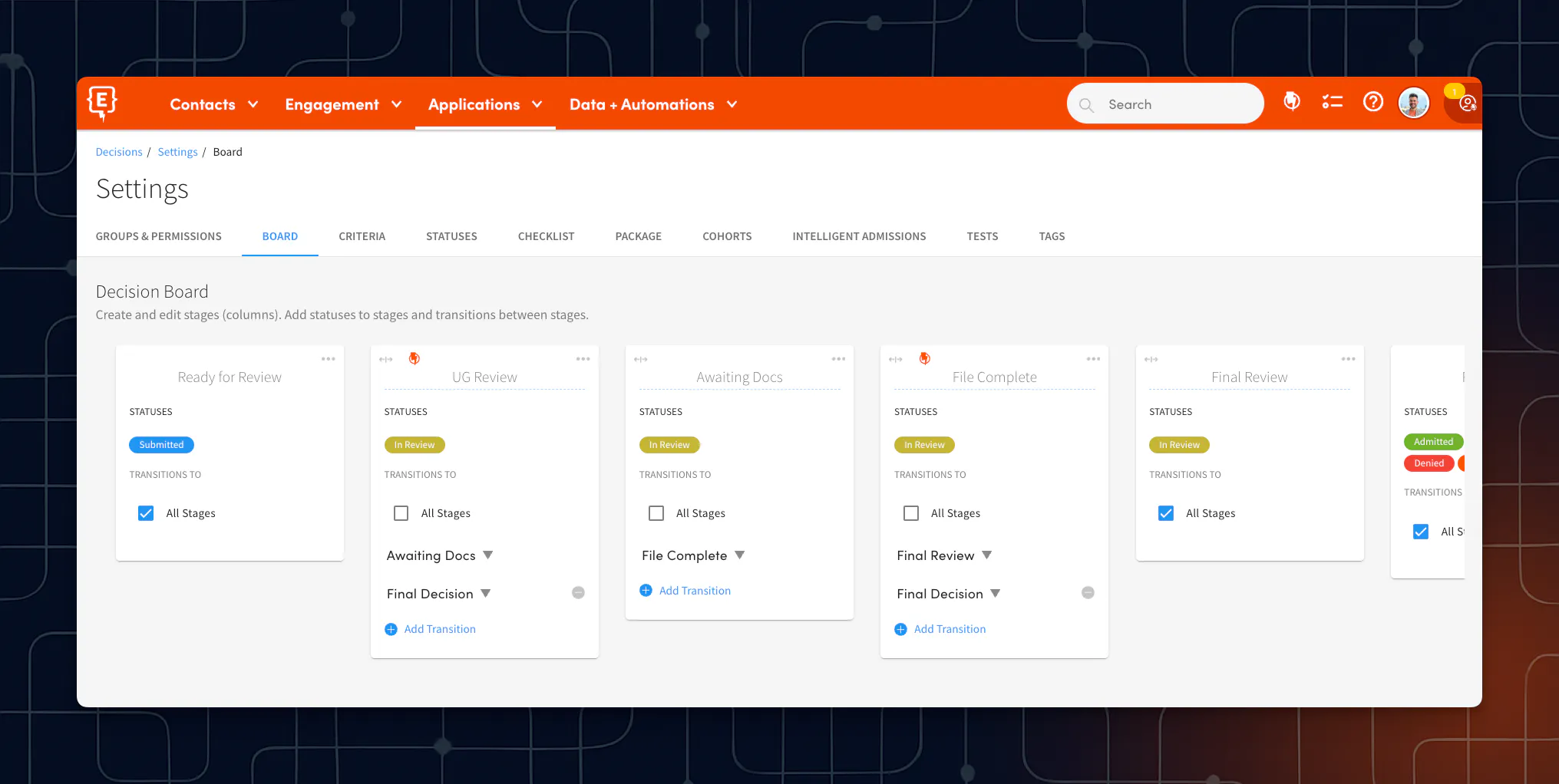
Step 1: Configure Your Evaluation Framework
◉ Configure your Decision board and map your admissions criteria to Element451
◉ Define intelligent admissions rules for auto-routing
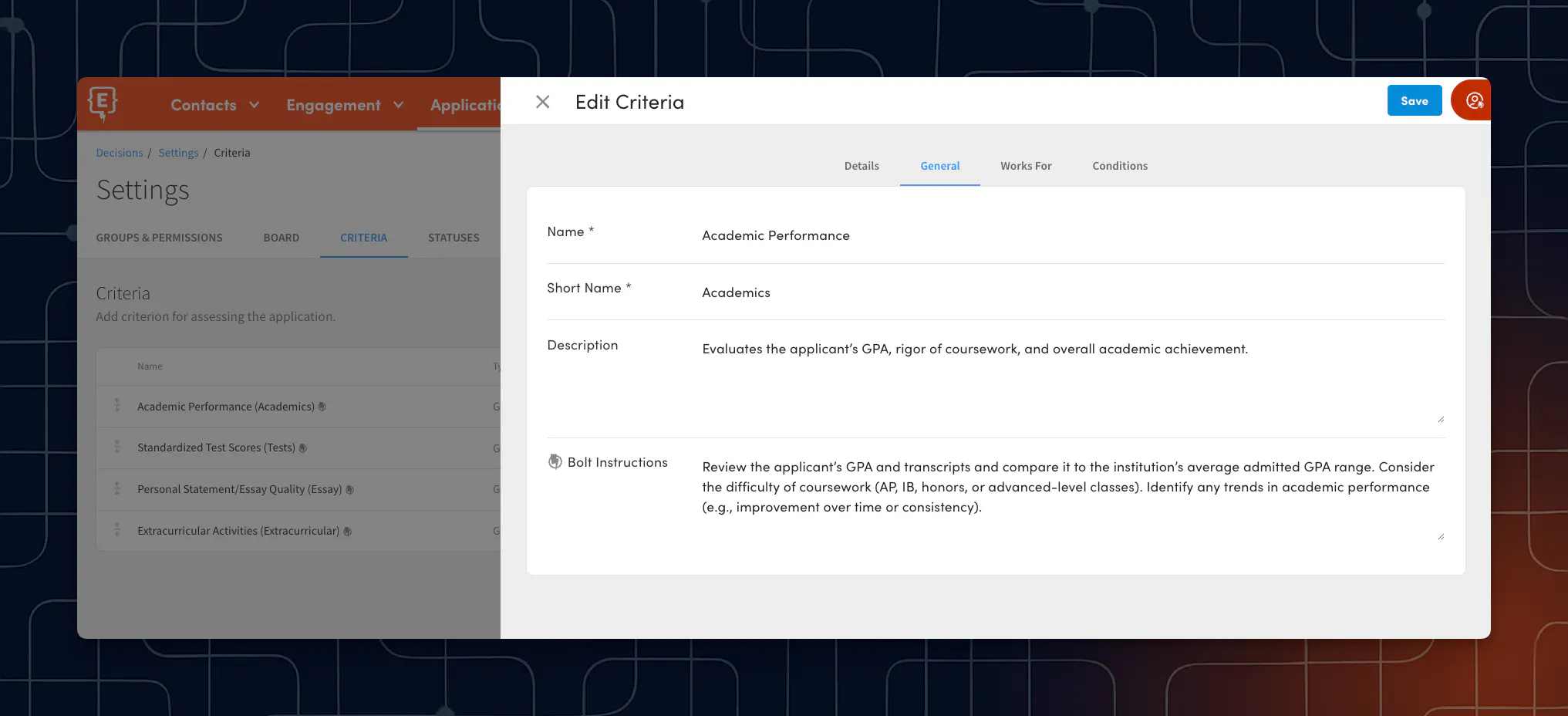
Step 2: Train Your
App Reader Agent
◉ Add detailed instructions for each criterion
◉ Include examples of strong/weak responses
◉ Define special circumstances to consider
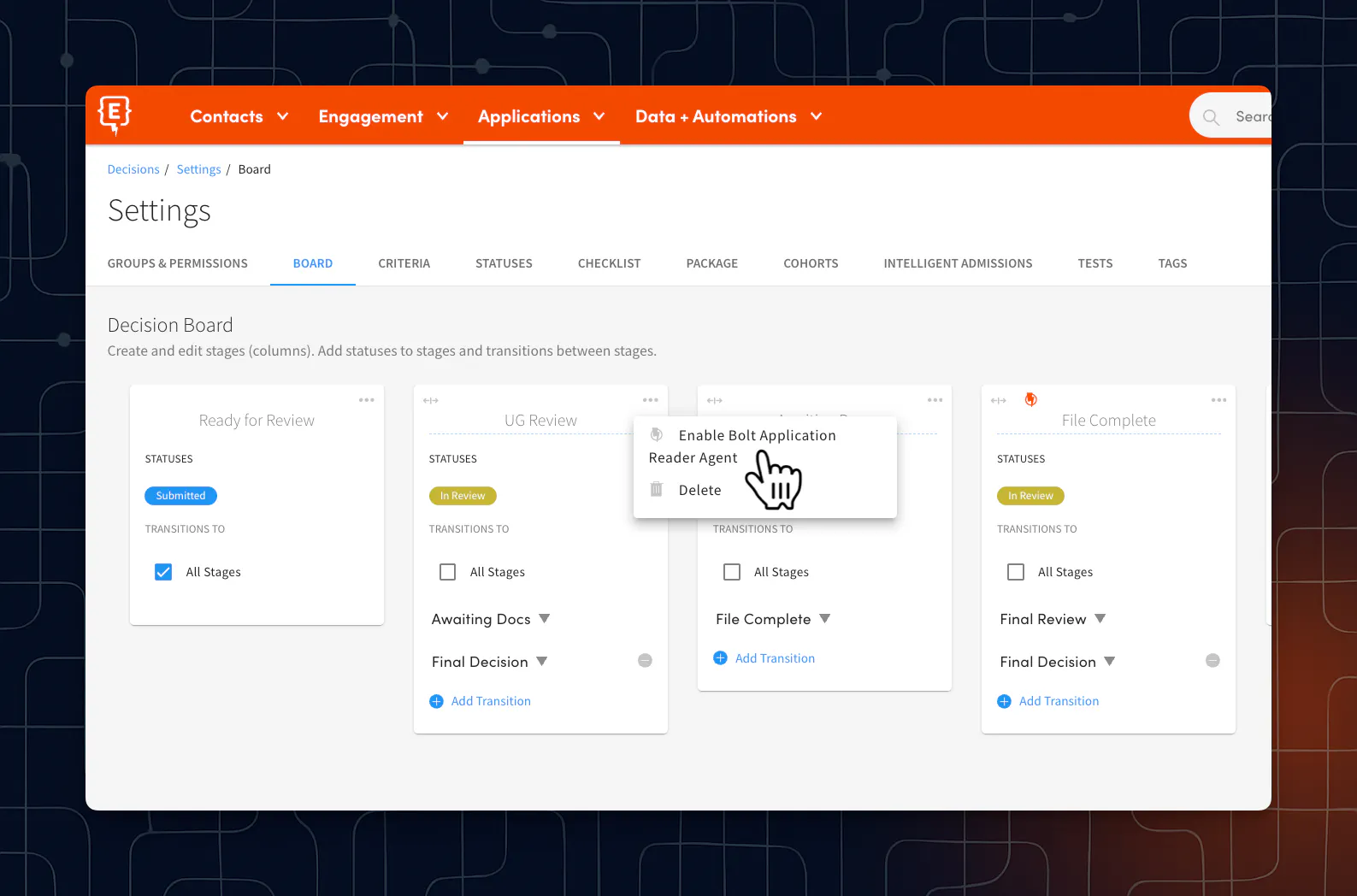
Step 3: Enable Your App Reader Agent
◉ Activate the agent for the designated Decision stages
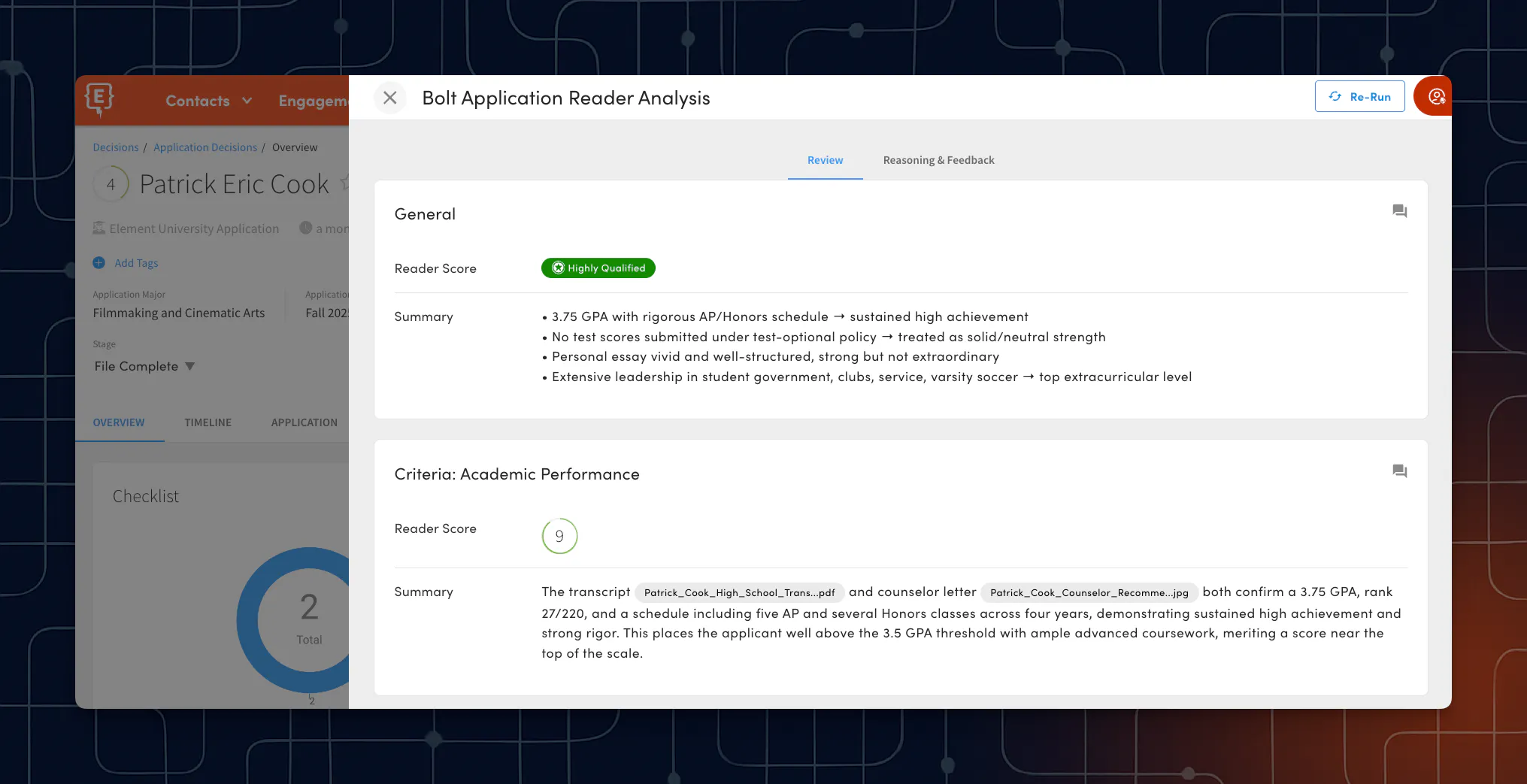
Step 4: Automatically Begin Application Review Process
◉ Applications enter the enabled stage
◉ The agent analyzes the criteria for which it’s enabled
◉ Scores assigned based on your settings
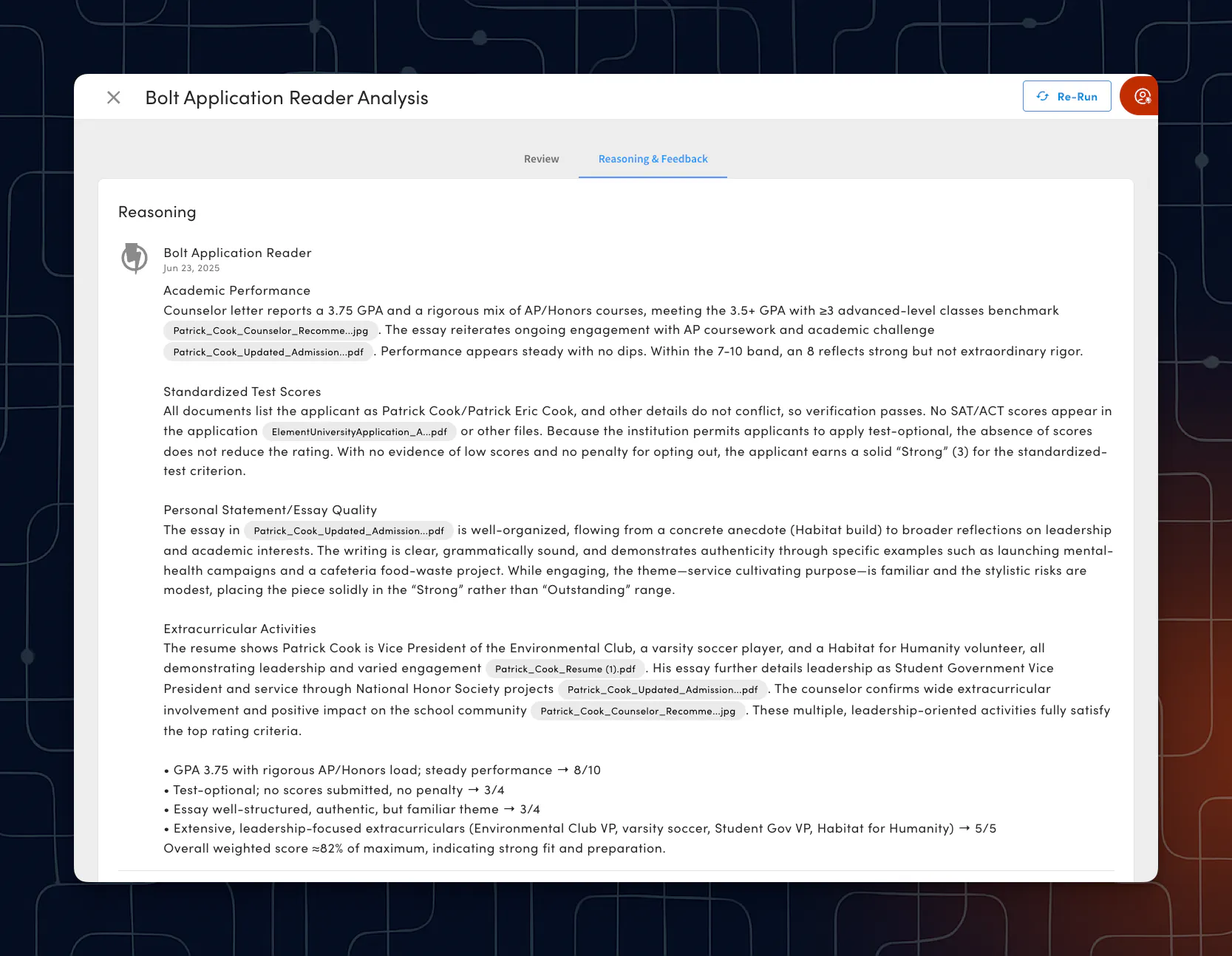
◉ Provides detailed rationale for each score
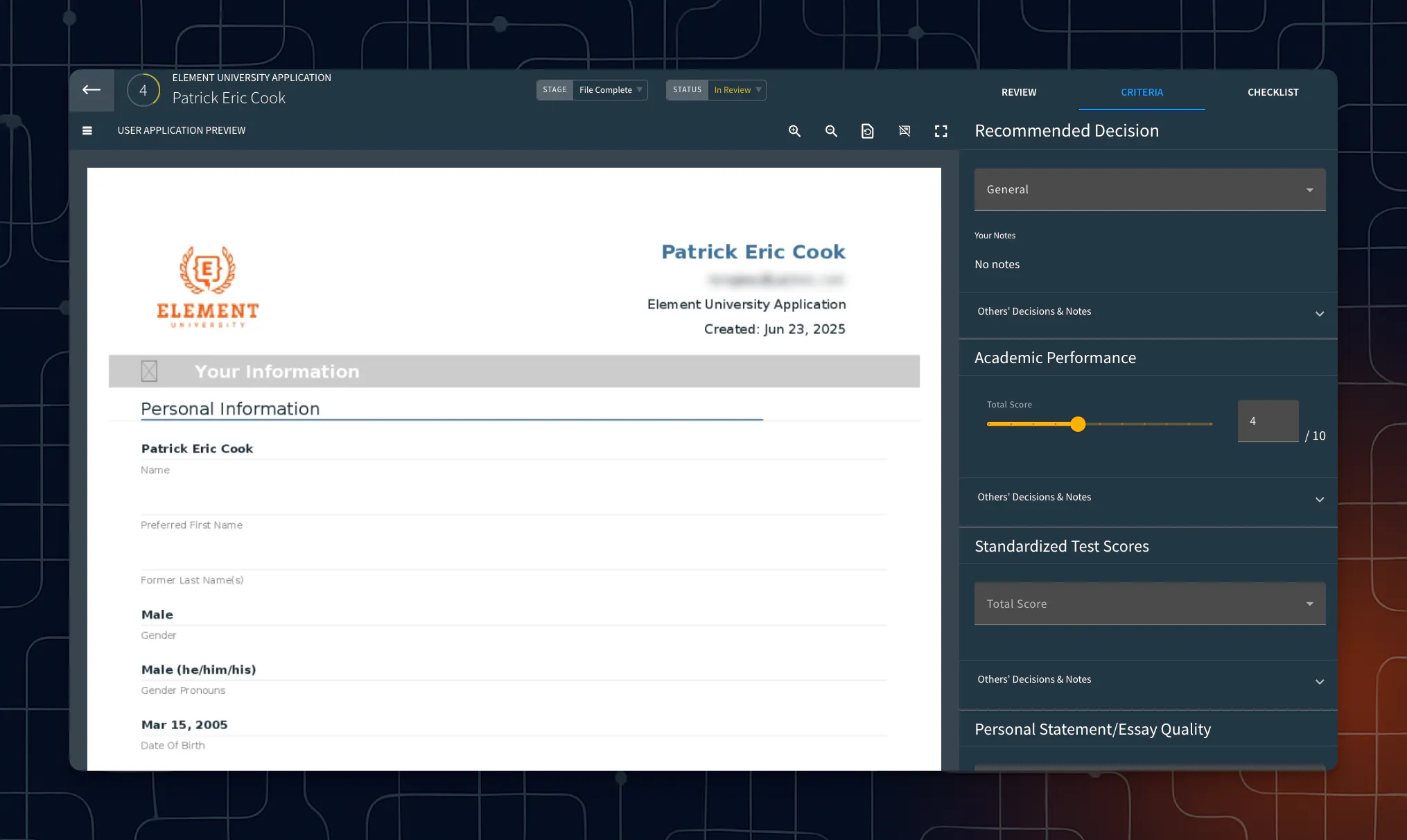
Step 5: Staff Review + Second Reads
◉ Staff conduct a focused second read on applications of your choosing
◉ Review the agent's analysis and rationale
◉ Provide feedback and re-run the App Reader Agent as needed
◉ Make final recommendations with confidence
Step 6: Continuous Improvement
◉ Analyze agent performance metrics
◉ Refine instructions based on outcomes
◉ Celebrate efficiency gains with your team
✨ Pro Tip: Teams typically pilot on a single program for two weeks, then expand across the portfolio once thresholds are tuned.
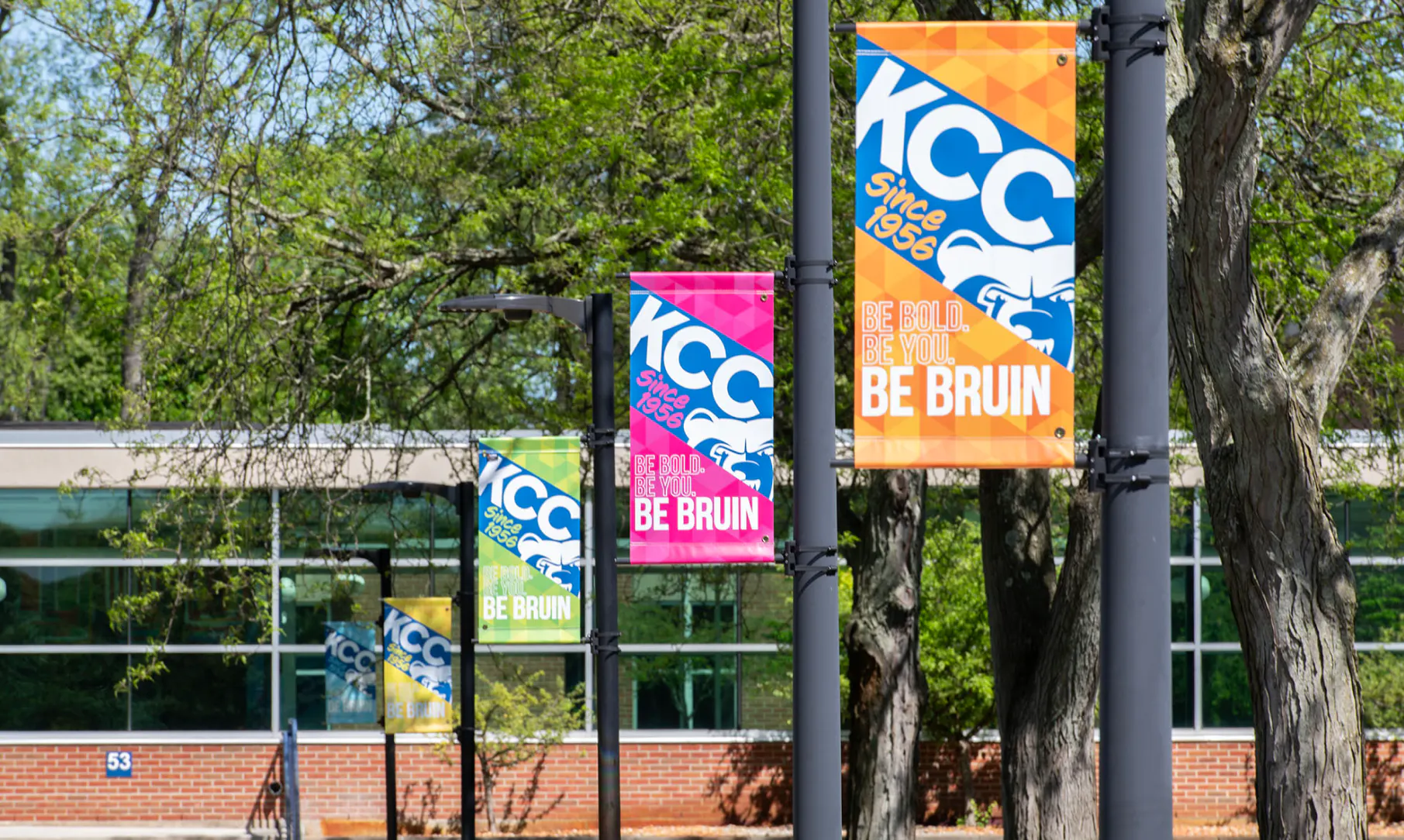
Kellogg CC. Proof That Speed and Fairness Win.
94% accurate (model‑to‑human agreement).
186 fraudulent applications flagged in 1 week.
Only 1 legitimate app flagged as high risk.
App Reading with Bolt Agents
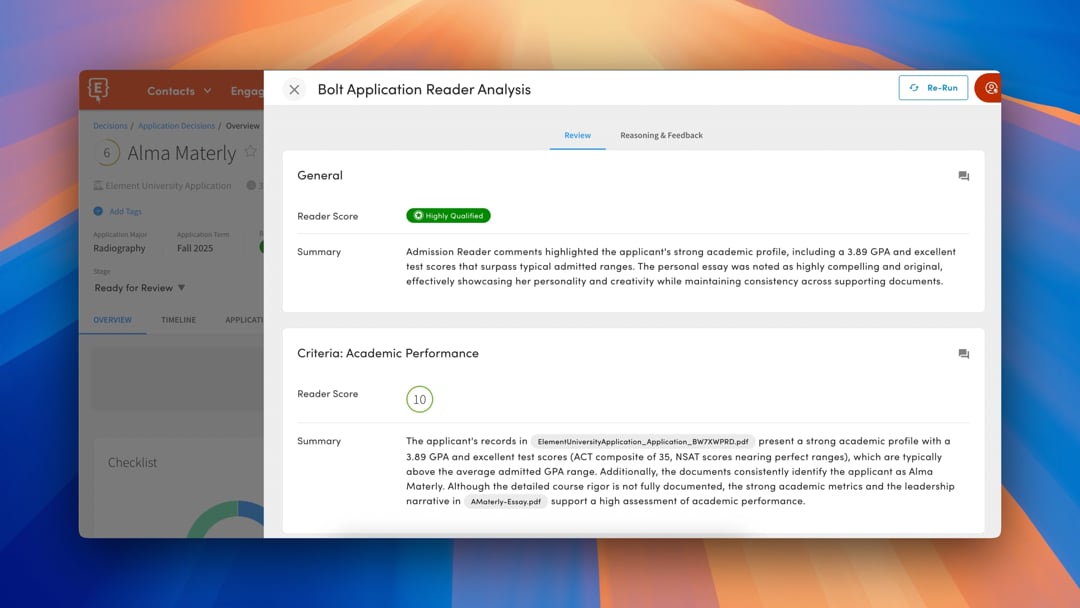
Bolt Application Readers generate a standardized first-read scorecard with an overall recommendation (Admit / Second Read / Deny / Waitlist), criterion-level scores (GPA, rigor, program fit, essays), and brief rationales for each.
They also flag issues—missing docs, identity concerns, inconsistencies—and auto-routes next steps (assign a second read). Humans always stay in the loop: counselors review, approve / override, add context, and finalize the decision.
Frequently Asked Questions
Book a consult now.
Ready to See It Live? Spin up your Application First Read playbook in 15 minutes.
Loading form…