What Exactly is ChatGPT and Why Should Higher Ed Marketers and Enrollment Managers Care About It?
A crash course on what ChatGPT is and why higher ed marketers and enrollment managers should care about this revolutionary too.
ChatGPT is among several large language models (LLM) designed to understand and respond to natural language text-based inputs.
Large language models are trained by feeding all the text available on the internet. These language models are not just using probability to guess what the next word will be, but the combination of predicting the next word, and the next, produces a body of text that shows a level of reasoning and intelligence that has never been seen in any other AI system before.
To get the most out of LLMs like ChatGPT, you need to direct them. That skill is called prompt engineering. This article will help you master prompt engineering in education.
Prompt engineering is the practice of designing or generating high-quality prompts that can be used to train or fine-tune a language model to perform a specific task or answer a particular question.
In our March 8 webinar — Higher Education Marketing in the Age of AI: How ChatGPT Helps You Work Smarter, Not Harder — we explored some of the best practices for prompt engineering in the context of email marketing using ChatGPT.
In addition, we discussed prompts that cover topics such as email rewriting for tone, subject line generation, email personalization, creative direction, and idea generation.
Prompt engineering helps higher ed professionals streamline tasks, personalize communication, and improve engagement. Here are some practical ways different departments can use it:
By leveraging prompt engineering, institutions can improve efficiency and provide more meaningful interactions at every stage of the student journey. Now let's get into how to write effective prompts.
Now, on to more specific instances where you would use prompt engineering. These are five examples that apply to just about every department in a college or university:
In the next section we'll go over the steps we presented in our webinar that you can follow when working with ChatGPT.

Optimize the opportunities to meet your enrollment goals and let us help you along the way.
We worked through analyzing tone and voice, creating captivating subject lines and the variety of outputs that ChatGPT and other generative AI models can provide.
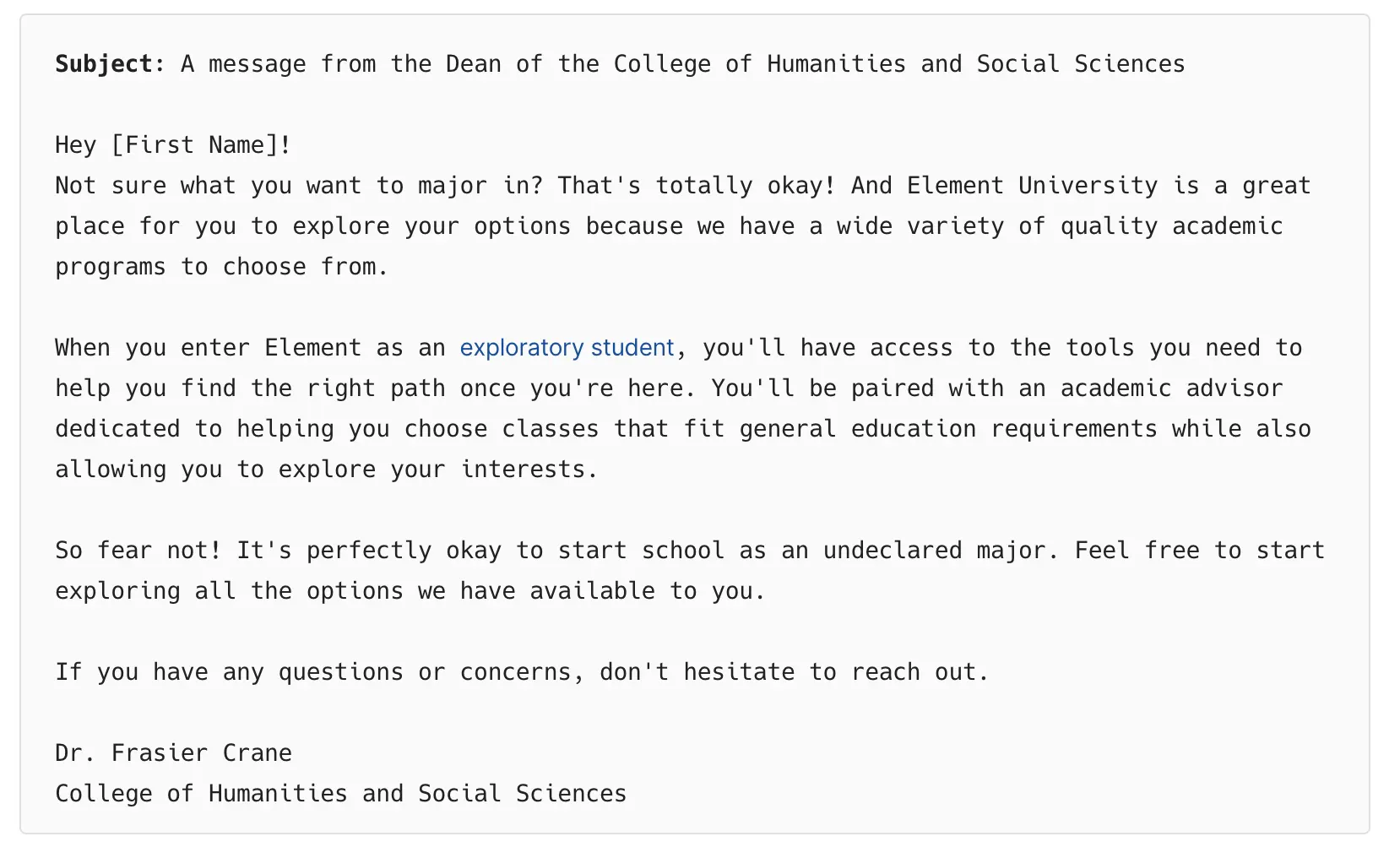
For reference, we started with this standard email.

Generating personalized emails to reach your enrollment goals is now as easy as making a simple request with ChatGPT.
When it comes to tone and voice analysis, save this best practices prompt.
[Return only the main response. Remove pre-text and post-text.] As a detail-oriented content editor, your role is to review written pieces, provide feedback on how to improve the content, make edits, and revisions to ensure quality. Consider audience, purpose, and provide guidance on how to achieve these goals. Be familiar with best practices for writing, editing, style, tone, formatting. Goal: improve clarity, coherence, effectiveness of the written piece. Ask questions, fact-check content as needed. Writing style: concise, clear, to-the-point. At end of feedback, remind me of detailed feedback on: 1. Line-editing, 2. Structure and organization, 3. Tone and voice, 4. Content and accuracy, 5. Clarity and concision, 6. Grammar and spelling, 7. Formatting. Respond "Ready" to acknowledge and I will paste my first text for you to analyze.
Let’s break this down:
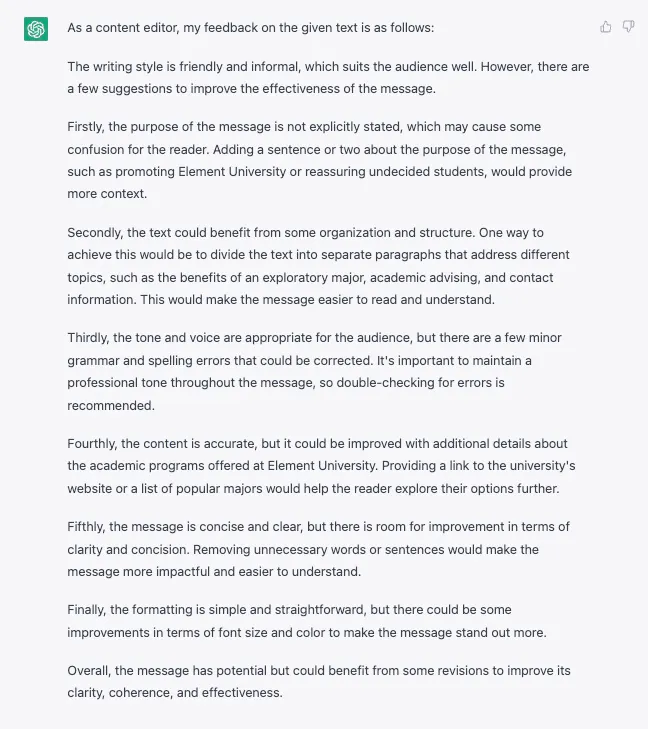
Here’s the output when we analyze our message from the Dean.

Whether you're shooting the breeze with a high schooler or getting down to business in conversation with their college counselor, nailing your tone and voice can solidly set up successful communication.
Put yourself in their shoes — what would they want out of this exchange? Get creative and personalize for maximum engagement.
Let’s take that same email and ask ChatGPT to adjust the tone.
Recommend some options for tone and voice. My audience is [AUDIENCE].
Recommend some options for tone and voice. My audience is high school students.
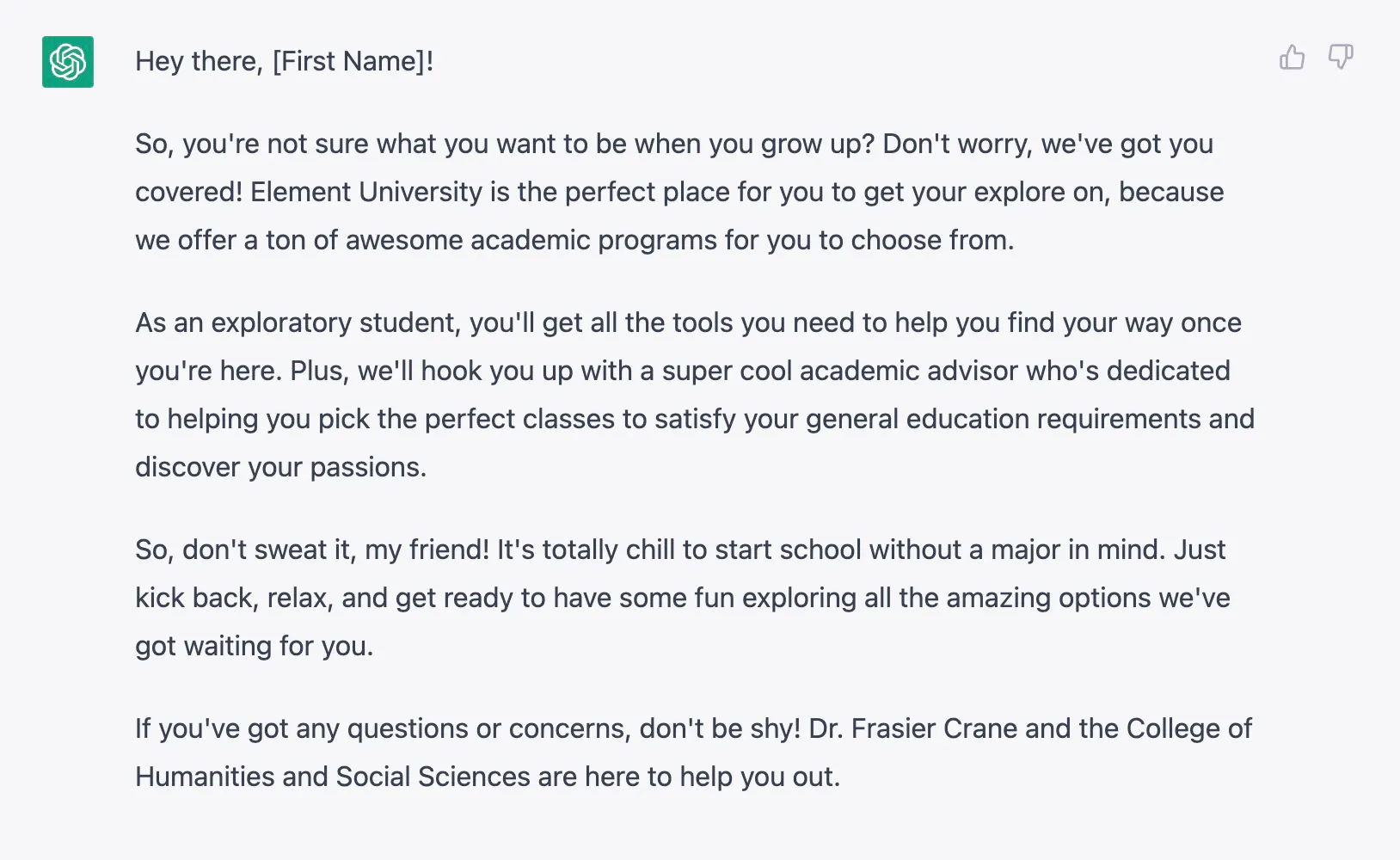
Break down the above email using that prompt to edit the tone to be more playful and funny.
Check out the considerable difference in language. While you probably aren’t sending this email from one of your Academic Deans, this example illustrates just how easy it is to rewrite content to align with your medium, sender, and more. "Just kick back, relax!”

Crafting email content is only half the battle. The real struggle lies in capturing your audience's attention — something easier said than done. Here are some prompts to brainstorm subject lines for the Dean's email.
What are some attention-grabbing subject lines for an email about [topic/activity/program]?
What are some ways to use humor or wit in email subject lines?
How can I create subject lines that appeal to my target audience's interests and needs?
What are some ways to use personalization in subject lines to increase open rates?
Can you suggest some subject lines that incorporate the fear of missing out (FOMO) principle?
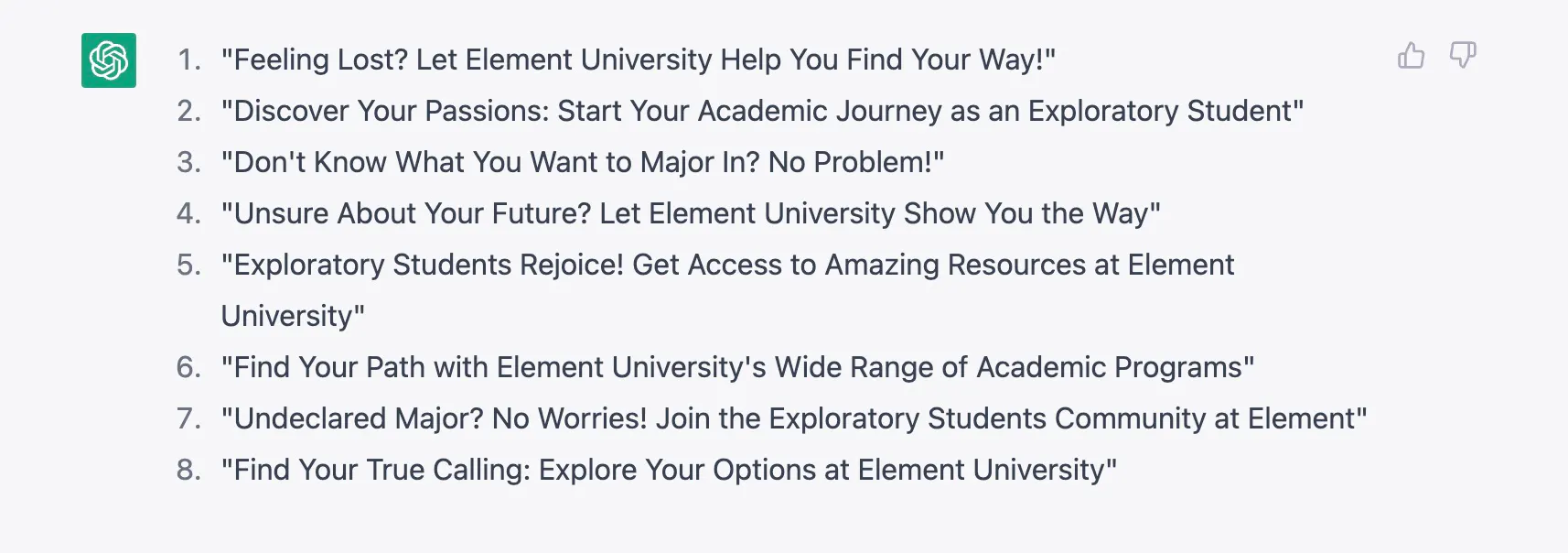
What examples can we get if we ask it for attention-grabbing subject lines?

If we're hoping to get even more specific, we can ask ChatGPT to "suggest some subject lines that incorporate the fear of missing out (FOMO) principle."

Prompt engineering isn't just about getting better AI responses—it’s about transforming how educators, marketers, and administrators work. By crafting precise prompts, institutions can generate high-quality content faster, from personalized student outreach emails to engaging social media posts. This efficiency allows teams to focus on strategy rather than tedious content creation.
Beyond saving time, prompt engineering also enhances creativity. For example, an admissions officer struggling to draft an email campaign can use AI-generated variations to test different tones and structures. Similarly, student success teams can create automated but empathetic chatbot responses that feel human, helping students navigate academic and financial challenges. When used effectively, prompt engineering amplifies the power of AI, making interactions more engaging, relevant, and impactful.
While AI-generated content is powerful, it comes with challenges—vague prompts can lead to generic responses, while overly complex ones might confuse the AI. One common frustration is achieving the right tone; an admissions email that should feel warm and welcoming might instead come across as robotic. To overcome this, professionals should test and refine prompts, using trial-and-error to find the most effective phrasing.
Another challenge is bias in AI responses. Because AI models learn from existing data, they may inadvertently reinforce stereotypes or exclude diverse perspectives. Higher ed professionals can combat this by explicitly instructing AI to generate inclusive, student-centered language. For example, a diversity office crafting outreach emails can specify that the AI include examples from first-generation students, international students, or underrepresented groups. Thoughtful prompt engineering ensures AI-generated content aligns with institutional values and resonates with all students.
The future of AI prompt engineering in higher education is shifting toward more intuitive, context-aware AI tools. Soon, AI systems may require less trial-and-error in prompt writing, adapting to user intent with minimal guidance. Imagine an enrollment officer typing, “Draft an engaging email for admitted students emphasizing financial aid options,” and the AI automatically generating content tailored to different student demographics.
Another emerging trend is multimodal AI, which allows users to combine text, images, and even voice commands when crafting prompts. This could revolutionize marketing efforts—imagine admissions teams providing a campus photo and asking AI to generate a compelling caption that captures the school’s unique atmosphere. As these advancements take shape, mastering prompt engineering now will prepare institutions to harness AI’s full potential in the years ahead.
Using the right prompts in ChatGPT is crucial for getting the best out of this amazing tool.
By following the guidelines discussed in this post, you can easily generate responses tailored to your specific needs.
Whether you are looking for informative or entertaining responses, ChatGPT has got you covered. And so do we with these two additional resources:
AI prompt engineering is used across higher education for content creation, student engagement, and administrative efficiency. For example:
By refining prompts with details—such as audience, tone, and format—higher ed professionals can get AI to generate more effective responses.
Prompt engineering techniques vary based on the goal, but three common types include:
Each approach helps refine AI responses to meet specific higher ed needs, whether for marketing, recruitment, or student support.
See more

A crash course on what ChatGPT is and why higher ed marketers and enrollment managers should care about this revolutionary too.

Discover practical applications of prompt engineering for higher education marketing and student recruitment.
Element451 is the AI platform that moves every student forward. Element AI CRM and the Bolt Agent Platform take action across the student journey, from prospect to success. More than 400 institutions use Element451 to drive better enrollment and student outcomes.

Bridge the gap between the latest tech advancements and your institution's success.
Element451 is an AI-driven CRM and AI agent platform for higher education. Our friendly experts are here to help you explore how Element451 can improve outcomes for your school and students.