The Future of Continuing Education and Workforce Development
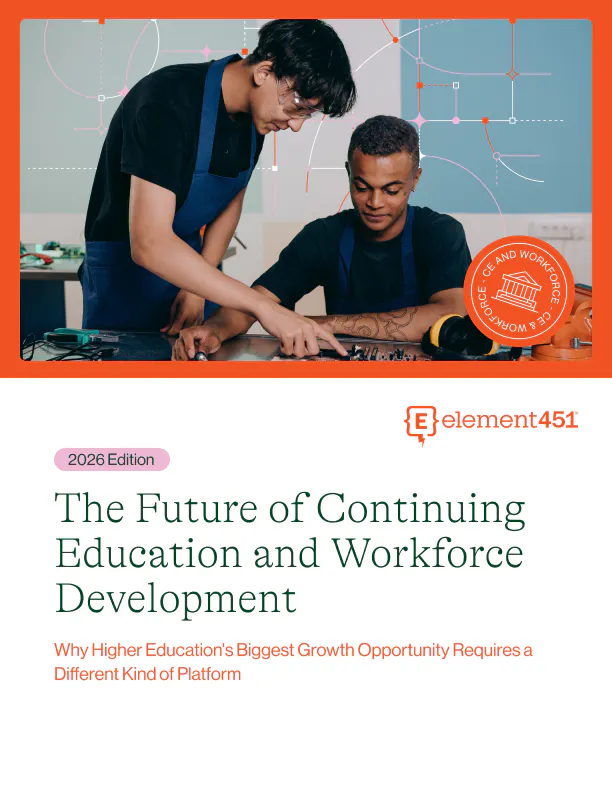
A Growth Opportunity Higher Ed Isn't Built to Capture
Non-degree credentials are growing faster than any other segment in higher education. Enrollment is up, adult learners are asking for shorter paths to a job, employers are dropping degree requirements, and as of July 1, 2026, Workforce Pell grants cover short-term programs for the first time in the program's history.
The opportunity is real. The infrastructure most CE and workforce teams run on is not built for it. Discovery happens in a static catalog. Enrollment runs through paper forms and disconnected payment systems. Employer partnerships live in one person's spreadsheet. None of it ties back to the outcomes data institutions now need to report.
That's where this guide comes in.
If your institution is looking to:
✔ Reach more prospective learners without adding headcount
✔ Turn a static course catalog into something learners actually use
✔ Build a workforce partnership pipeline that survives staff turnover
✔ Report enrollment, revenue, and outcomes data your boards and funders require
This guide walks through what's changed in the CE and workforce market, where the learner experience breaks down today, and how to close the gap.

What's Inside the Guide
Discover what's driving non-degree growth, where the learner experience breaks down today, and how to close the gap with the right technology. Inside, you'll find:
1️⃣ The Market Moment
The demand, employer, and funding shifts making non-degree programs higher education's biggest growth opportunity right now.
2️⃣ Where the Learner Experience Breaks Down
The four-stage non-degree journey, discovery, enrollment, delivery, and credentials, and why each one typically runs through a different system.
3️⃣ Four Challenges CE Teams Face Every Day
The structural problems limiting growth: budgets that don't match the mandate, catalogs that don't convert, partnerships stuck in spreadsheets, and legacy tools that can't keep up.
4️⃣ Two Paths Forward
How to know whether your institution needs an AI engagement layer on top of what you already run, or a full platform built around it.
5️⃣ What Changes for CE and Workforce Teams
What personalized discovery, managed partnerships, and reportable outcomes look like once the infrastructure catches up to the opportunity.
6️⃣ Look at Element451's CE and Workforce Products
How Bolt for CE and Workforce and Element for CE and Workforce fit institutions at different points in their technology journey.

A Closer Look at Continuing Education and Workforce Growth
This guide covers the four forces making non-degree credentials higher education's fastest-growing segment, and the four-stage learner journey, discovery, enrollment, delivery, and credentials, that most institutions still run through disconnected systems. You'll see the four challenges holding CE and workforce teams back. But the real guidance starts with the two paths forward: whether your institution needs an AI layer on top of what you run today, or a full platform built around it.
Why This Guide Matters
CE and workforce divisions are being asked to grow like a business unit while running on a fraction of the resources they need. The right platform changes that math.
✔ Reach learners without hiring more staff. AI agents handle outreach and program matching around the clock, including the 2am search a working parent makes after the kids are asleep.
✔ Turn partnerships into a pipeline, not a memory. Employer relationships get a system of record instead of living in whoever manages them today.
✔ Register learners in a single session. Discovery and enrollment happen in one place instead of forcing learners through separate tools.
✔ Report outcomes with numbers, not anecdotes. Enrollment, completion, and revenue data live in the same system, ready for funders, boards, and Workforce Pell compliance.

The Future of Continuing Education and Workforce Development
Non-degree enrollment is growing, funding has arrived, and the learner population is ready. The only thing standing between institutions and that growth is the infrastructure. This guide shows you how to close the gap.
Loading form…