1️⃣ Why AI, and Why Now
The structural pressures driving adoption: staffing shortages, shifting student expectations, and declining public confidence in higher ed.

Whether your institution is looking to:
✔ Understand the difference between predictive, generative, and agentic AI, and which one solves your actual problem
✔ See real results from institutions like yours before you start evaluating vendors
✔ Get staff and leadership aligned on AI as a capacity tool, not a replacement for people
✔ Build a practical framework for spotting vendor hype before you're deep in an RFP
This guide walks through where AI is already working across the student lifecycle, what it takes off staff plates, and what to ask before you commit to a platform.

The structural pressures driving adoption: staffing shortages, shifting student expectations, and declining public confidence in higher ed.
A plain-language breakdown of the three types of AI that matter most: predictive, generative, and agentic.
Real, named results from recruitment through student success.
What AI can take off a team's plate, and what has to stay human.
Why integrated systems outperform isolated point tools, and what a connected platform actually does.
Common obstacles to adoption, the traits of institutions getting real results, and a practical checklist for vendor conversations, including ethics and governance questions worth asking first.
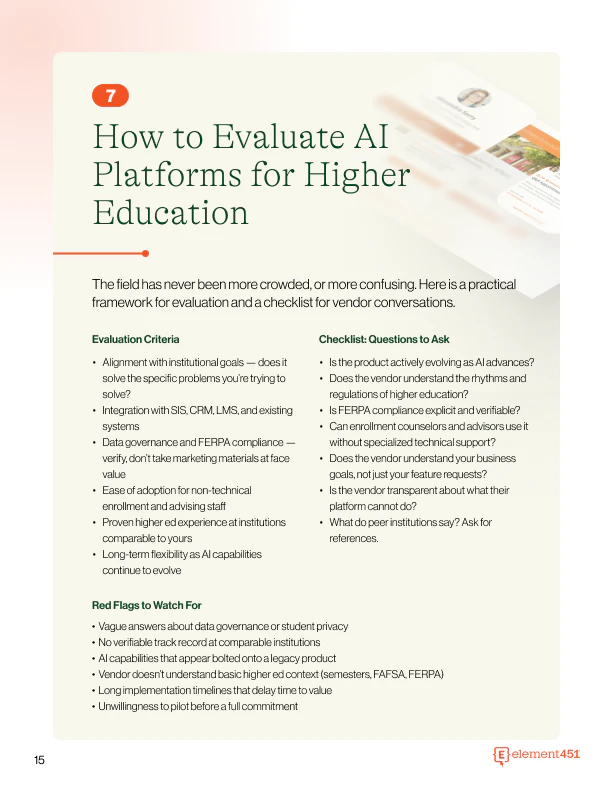
This guide covers where AI is already producing results across recruitment, admissions, enrollment, and student success, backed by real numbers from institutions doing the work today. You'll see what leading institutions are doing differently, the shared patterns behind results that actually hold up. It walks through the ethical and governance questions your institution needs to answer before selecting a platform, then turns that into a practical framework for building a real AI strategy. That framework gets most specific in the section on evaluating AI platforms: six criteria built for higher ed, the exact questions to ask a vendor, and the red flags that tell you when to walk away.

Institutions using AI well aren't just adopting a tool. They're building capacity.
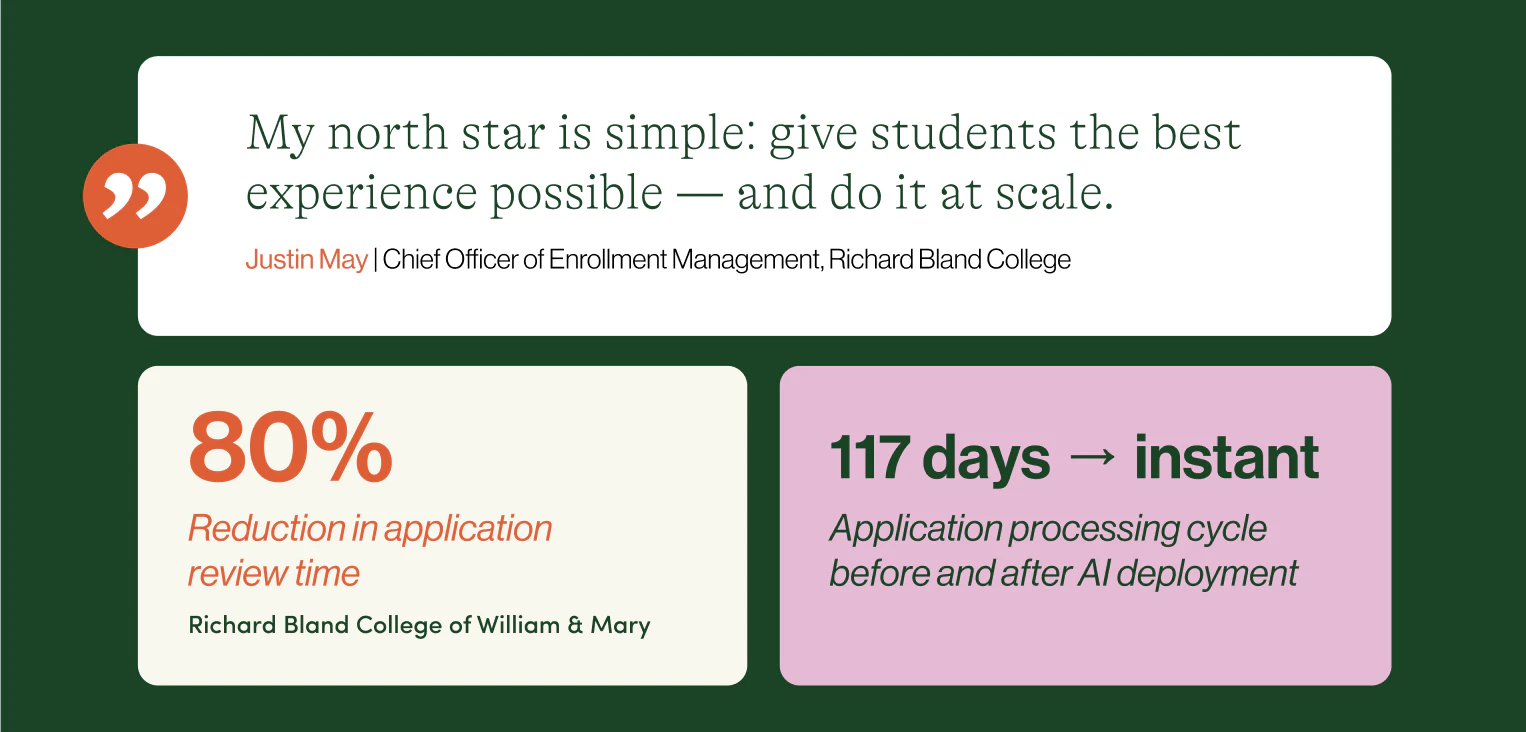
✔ Richard Bland College cut application review time by 80%, moving from a 117-day cycle to near-instant decisions.
✔ Southeast Missouri State saved an estimated 160,000 minutes of staff time by automating admissions workflows.
✔ Texas State Technical College grew enrollment 33% across 11 campuses over 8 consecutive semesters, while cutting cost per application from $424 to $81.
✔ Clayton State University grew enrollment 7% while cutting staff workload by 75%, freeing advisors for the work that actually moves students forward.
AI doesn't replace the relationships that make higher ed work. It gives staff the time back to build them.


Three types of AI. One student journey. Everything you need to separate real capability from vendor hype, before you start evaluating platforms.