1️⃣ Why Retention Is the New Enrollment Strategy
The three forces squeezing institutions: a shrinking pipeline, rising student expectations, and advisors stretched past capacity.
Retention is no longer a downstream metric. With enrollment declining and advisor caseloads running into the hundreds, sometimes over 1,000 students each, institutions can't recruit their way out of the pressure they're under.
The signals that a student is at risk show up early: missing assignments, unpaid balances, declining LMS logins. But those signals live scattered across the SIS, the LMS, financial systems, and case management tools. By the time an advisor pieces the full picture together, the student may already be gone.

✔ Catch at-risk students earlier by combining academic, financial, and behavioral signals in real time
✔ Give advisors back their time by automating repetitive outreach and connecting fragmented systems
✔ Evaluate AI-enabled platforms with confidence using a clear, eight-factor framework instead of a feature checklist
✔ Roll out change without disrupting staff with a pilot-first approach and a practical, step-by-step checklist
This guide walks you through all of it, from why students disengage to what to ask every vendor before you buy.


The three forces squeezing institutions: a shrinking pipeline, rising student expectations, and advisors stretched past capacity.
The five reasons students disengage, and the warning signs that show up before a student decides to withdraw.
Support that meets students before they apply, while they're enrolled, and after they graduate.
What a real early alert system needs to work, and where AI expands staff capacity without replacing the advisor relationship.
The eight factors that matter most, plus the exact questions to ask every vendor before you sign.
Data fragmentation, departmental silos, staff resistance, and vendors who overclaim.
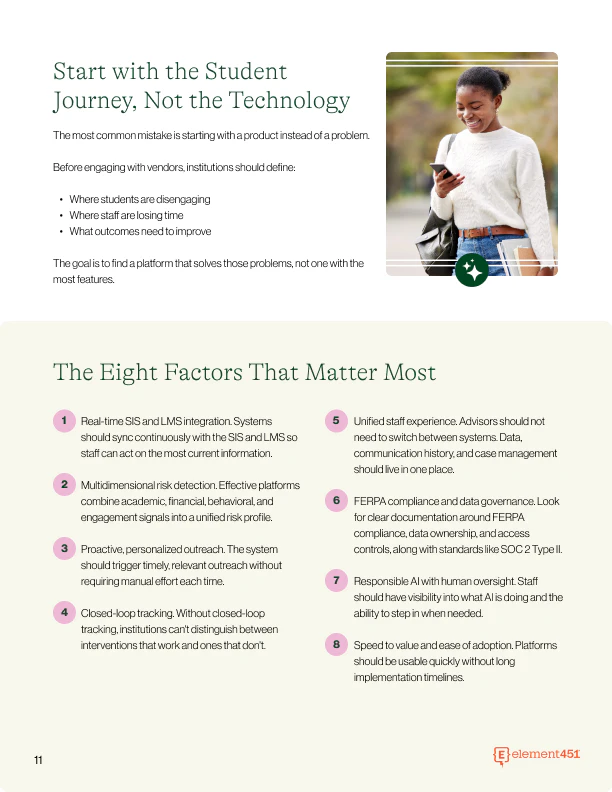
This guide covers the three forces squeezing enrollment and retention today, the five reasons students actually disengage, and a framework for supporting them across the full lifecycle, before they apply, while they're enrolled, and after they graduate. You'll see what a real early alert system needs to work, the common obstacles that stall adoption, and a step-by-step checklist for rolling out change without disrupting staff. That framework gets most specific in the section on evaluating AI-enabled platforms: eight factors built for higher ed, the exact questions to ask every vendor before you sign, and what to ask about bias testing and human review.


The right framework doesn't just compare vendors. It changes what your advisors can see.
✔ See risk earlier, before it shows up in final grades or a withdrawal form.
✔ Give advisors a single view of each student instead of five different logins.
✔ Ask vendors sharper questions, including how they test for bias and what always requires human review.
✔ Free staff to focus on the students who need them most, without cutting headcount.
✔ Pilot before you scale, so you catch gaps early instead of after a full rollout.

An eight-factor framework for evaluating AI-enabled student success platforms, and the questions to ask before you buy.