
From Inquiry to Completion: How CCBC Redesigned the Student Experience
Updated Oct 01, 2026
Most institutions have a student journey. Few have stopped to ask whether it was designed for students or just inherited over time. The Community College of Baltimore County decided to find out — and then rebuild it from the ground up. Here's what that looked like.
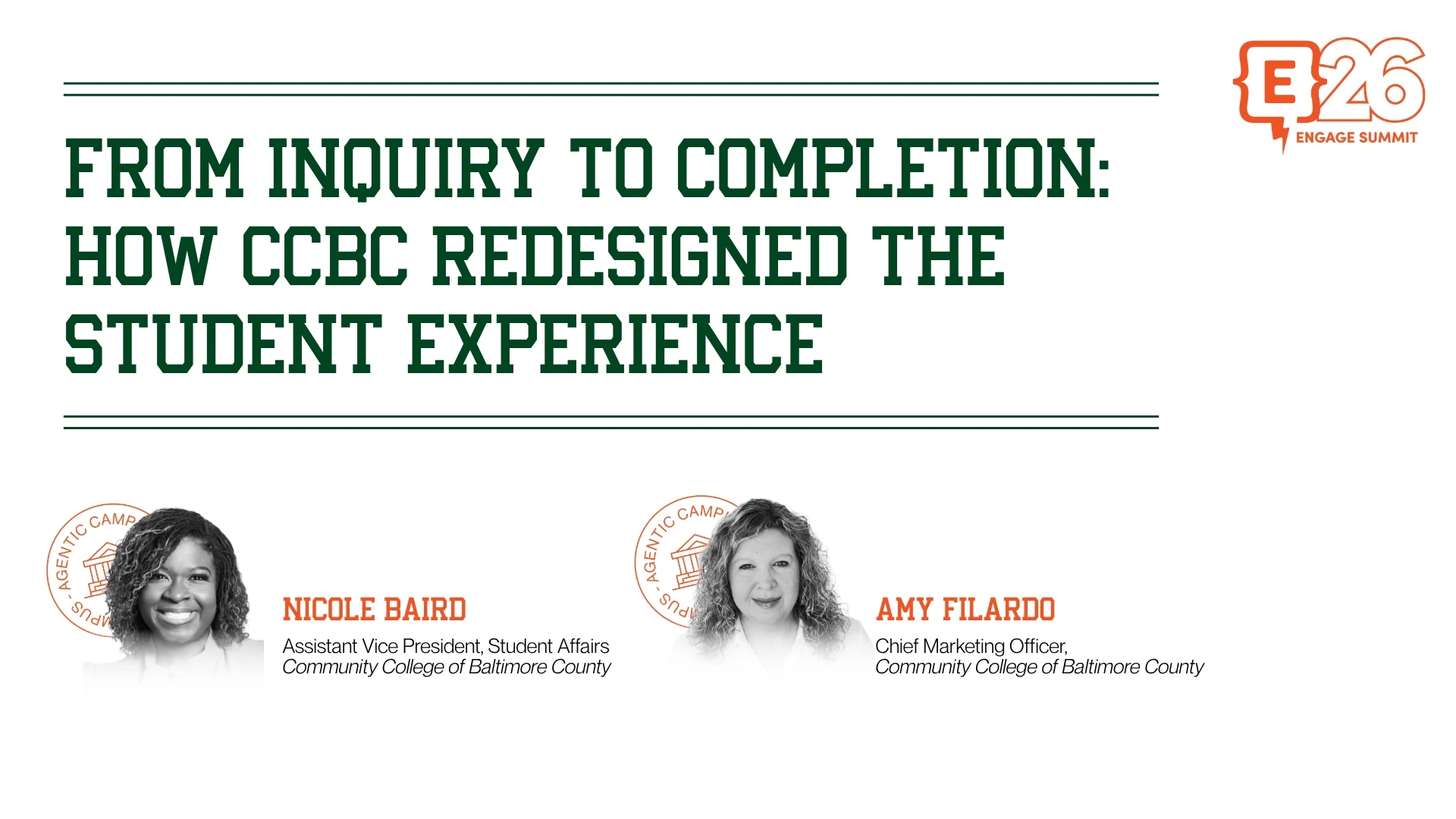
The Community College of Baltimore County is not a small operation. With six campuses, more than 52,000 students, over 300 programs, and a tuition-free initiative that covers roughly 90% of eligible students, CCBC is one of the more complex community college environments in the country. They are also an Element451 partner.
But this isn't a technology story. It's a story about what happens when an institution decides to stop layering solutions on top of broken processes and instead asks a harder question: what does the student experience actually need to look like, and how do we build toward that on purpose?
At Engage Summit 2026, CCBC Chief Marketing Officer Amy Filardo and Assistant Vice President of Student Affairs Nicole Baird walked through exactly how they answered that question, including the methodology they built, the two areas where they put it into practice first, and what they learned along the way. The full session is available on-demand as part of Engage Digital Summit 2026, alongside 50+ additional sessions.
Start With the Student, Not the System
Before CCBC touched a workflow, a CRM configuration, or a communication plan, they started with a persona. They named her Tallulah.
Tallulah wasn't a demographic profile. She was a stand-in for every student CCBC serves: a neighbor, a family member, someone the team genuinely cared about. The exercise was intentional. By designing the student journey for Tallulah, rather than for internal convenience or legacy process, CCBC forced themselves to confront what the experience actually felt like from the student's side.
That meant auditing every barrier. Every point in the process where a student might stall, disengage, or simply not know what to do next. Every communication that was unclear, missing, or timed wrong. Every policy that existed because it had always existed, not because it served students. The team wrote all of it down and then asked: if this were happening to someone we cared about, would we accept it?
The answer shaped everything that followed.
Building the New Journey for Students
The output of that process was a physical document: CCBC's New Journey for Students, or the NSJ. It took two months to produce, required representatives from virtually every corner of the college, and runs long enough that Nicole carries it with both hands.
The NSJ isn't a flowchart. It's a structured, chapter-by-chapter framework that maps every stage of the student lifecycle from prospect through alumni status, with a deliberate loop back to prospect for graduates. Each chapter follows the same consistent structure: a stated goal for that stage, agreed-upon definitions of terms (because the same word meant different things in different departments), activities and touchpoints, communication workflows, and technical requirements.
One of the framework's most practical contributions was the concept of Meaningful Interaction Points, or MIPs. A MIP can be low, medium, or high. A low MIP might be a birthday message. A high MIP might be a hold placed on a student's account that triggers a mandatory advising meeting. The language matters too: CCBC deliberately shifted away from calling students "at risk" toward asking whether a student is "on track" or "not on track." A small change in framing, but one that changes how staff approach those conversations.
Building the NSJ also forced a cross-institutional reckoning with how siloed the college had become. The same terminology meant different things in different offices. Frontline staff had deep institutional knowledge that existed nowhere in writing. Senior leadership needed to be aligned before anything could move. Getting there required executive sponsorship from the president down, departmental representatives at the table, and a joint council at the dean level facilitating the process across the institution.
Where It Came to Life: Application and Advising
The NSJ was the map. The application redesign and advising overhaul were the first two places CCBC drove it into the ground.
The Application
Before Element451, CCBC ran on the Banner application. Anyone who has worked with it understands the experience. Students could start down the wrong application type without knowing it. There was no proactive outreach for incomplete applications. And the college was also dealing with a surge in fraudulent applications layered on top of everything else.
The redesign focused on simplifying the path and meeting students where they were. CCBC worked toward a single application with branching logic, so students could self-select the right path through prompts rather than prior knowledge. Required fields were scrutinized: if a field was required, there had to be a defensible reason. Communication flows were built to reach students at the right moments, including reminders for incomplete applications and clearer next-step guidance after submission.
Fraud detection was addressed through SAFE, a software layer that flags markers associated with fraudulent applicants and triggers a documentation request process. The combination of a cleaner application and active fraud detection has brought fraudulent applicants getting through to something close to zero.
The results: application numbers are up approximately 5% year over year, and trending upward from the prior year as well.
Academic Advising
When the advising redesign began, CCBC had 10 full-time academic advisors supporting 24,000 students across six locations. There was no case management model because there couldn't be: the math didn't support it. Advisors were using four different systems, roles were unclear, and students had no consistent point of contact through the enrollment process.
Nicole's response was to build a proposal, not just make a request. Using a project management office template, the advising leadership made the case with data: national advisor-to-student ratios, pathway-level retention analysis, projected impact with additional headcount, and student survey data on what they wanted from an advising relationship.
The proposal worked. CCBC was awarded 37 full-time academic advisors.
The new model created two distinct roles with a defined handoff. College Transition Advisors own the student relationship from pre-enrollment planning through the first day of school. Pathway Advisors take it from there through completion and alumni status. Every advisor carries defined caseload benchmarks, retention targets written into their job descriptions, mental health first aid certification, and a life coaching certification funded through the institution's Title III grant.
The early results: a 4% increase in fall-to-fall enrollment in the first year of the new model.
What They Learned
CCBC was candid about what made this hard, and what they would tell other institutions going through a similar process.
Write everything down. Standard operating procedures weren't optional, they were foundational. Institutional knowledge that lives in people's heads can't be standardized, trained to, or handed off. CCBC worked systematically to document processes from something as basic as answering the phone to something as complex as communicating academic dismissal.
Change management is the work. Getting the NSJ written was significant. Getting people to actually change how they do their jobs was harder. CCBC invested in change management certifications at the leadership level, ran ongoing focus groups with frontline staff, and built a communication cadence that kept the entire college informed throughout the process. The advice on resisters was direct: identify them early, have the sidebar conversation before the big presentation, and keep the ship moving.
Project management infrastructure matters. Five hundred deliverables require more than good intentions. The college's project management office was essential in sequencing work, managing capacity across leads, and keeping parallel workstreams from collapsing on each other.
Done is relative. The application launched before it was fully finished. The advising model is still being built out. That's not failure; it's the reality of institutional change at scale. The framing that helped: you can launch something and still have more work to do. Progress and completion aren't the same thing.
Watch the Full Session
This session is available on-demand as part of Engage Digital Summit 2026. Watch it and explore 50+ additional sessions at element451.com/engage-digital-2026.

About Element451
Boost enrollment, improve engagement, and support students with an AI-driven CRM and agent platform built for higher ed. Element451 makes personalization scalable and success repeatable.
Categories
New Blog Posts



The Definitive Guide
AI in Higher Education
Bridge the gap between the latest tech advancements and your institution's success.

Talk With Us
Element451 is an AI-driven CRM and AI agent platform for higher education. Our friendly experts are here to help you explore how Element451 can improve outcomes for your school and students.
Get a Demo