What 15 Years of Manual Deduplication Taught Me About Trusting AI

by Eric Range · Aug 04, 2026
Element451's new Deduplication experience pairs Bolt's agentic ability with staff judgment, turning one of higher ed's most tedious data-quality tasks into a fast, explainable workflow that keeps every merge decision in your team's hands.
Before I was Element451's VP of Product, I spent 15 years on the campus side of higher education — student affairs, residence life, and eventually enrollment management at Drew University, where I oversaw marketing, data analytics, and CRM operations across undergraduate, graduate, and theological school admissions. So when I say deduplication is a problem I've lived, I mean that literally: I've been the person staring at two records on two monitors, trying to figure out which one to keep.
A Problem I Know From the Inside
Drew wasn't a large institution. We processed about 5,000 applications a year and another 20,000 to 25,000 inquiries, on top of the search names we bought. Even at that scale, we were dealing with tens of thousands of potential duplicates a year — applications from the Common App, test scores from ACT, SAT, and TOEFL, and name buys from half a dozen sources, all landing on top of each other.
The process was almost entirely manual. During peak admissions season, we'd hire part-time staff — effectively a person and a half working — just to work through duplicate queues: matching new documents to the right person, cleansing data, merging records by hand. It wasn't glamorous work, and it wasn't cheap to maintain an ongoing headcount cost to keep our contact data clean.
And the cost didn't stop at labor. Messy, duplicated data has a way of surfacing at the worst possible moments — a student who gets the same email three times because they exist three times in your database, or one who receives a mix of unrelated content because their communication history is split across records. It's a bad experience for the student, and it gets messier the longer it lingers, especially once it flows downstream into your student information system.
Why the Old Scoring Rules Only Get You So Far
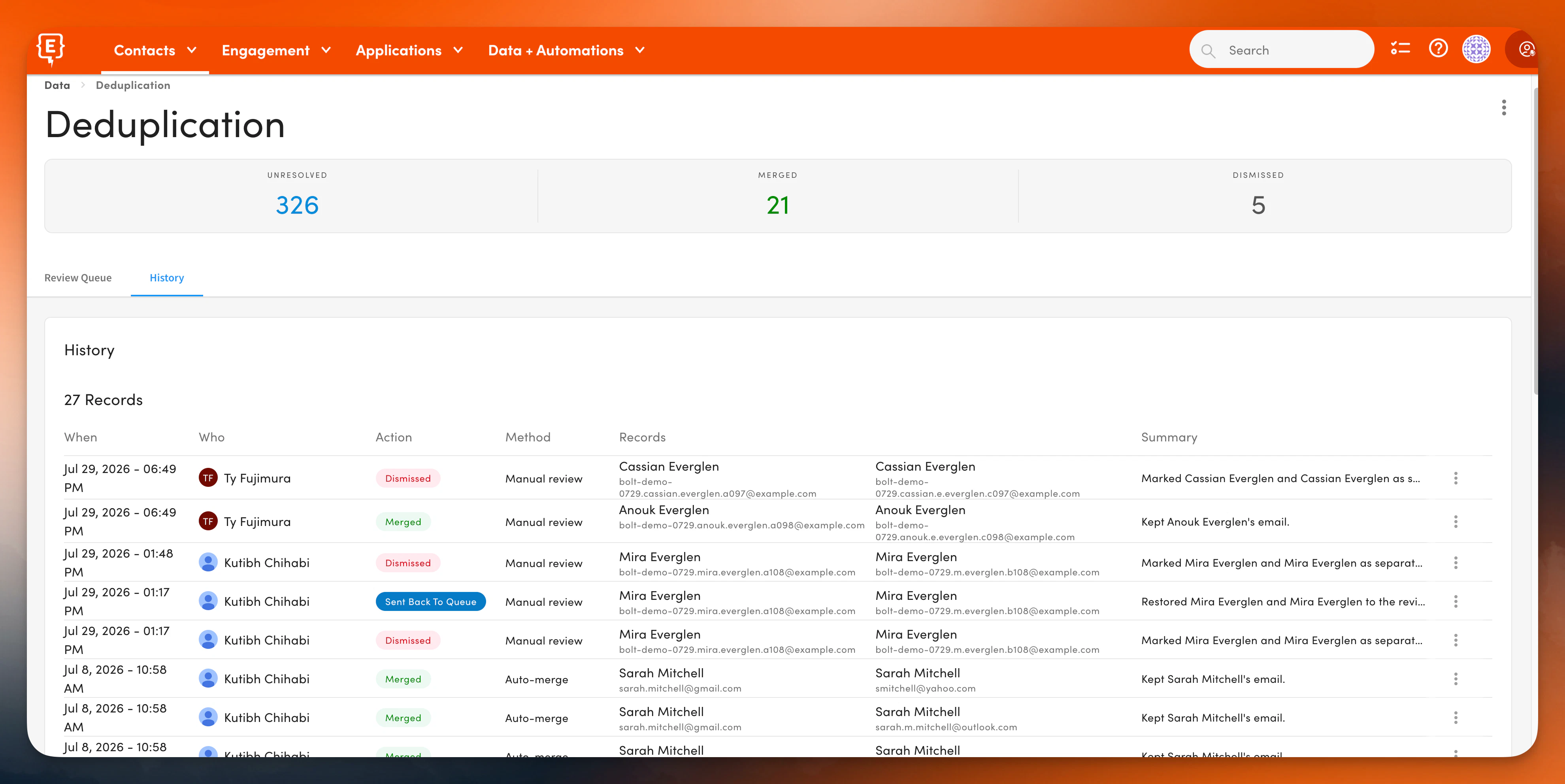
The traditional approach to deduplication — including the version we shipped at Element451 until now — relies on a deterministic set of rules: if first name, last name, and zip code match, or first name, last name, and date of birth match, flag it as a potential duplicate. That logic works, to a point. But it doesn't tell you why two records matched, which one should stay, or what to do when the signals conflict. It just hands you a queue and a score you're asked to trust.
That's the part I think gets underestimated. Identifying a likely duplicate has never really been the hard part. The hard part is knowing which creation date to keep, which source to preserve, and how to weigh conflicting information when two records clearly represent the same person but disagree on the details.
What's New: Bolt AI That Shows Its Work
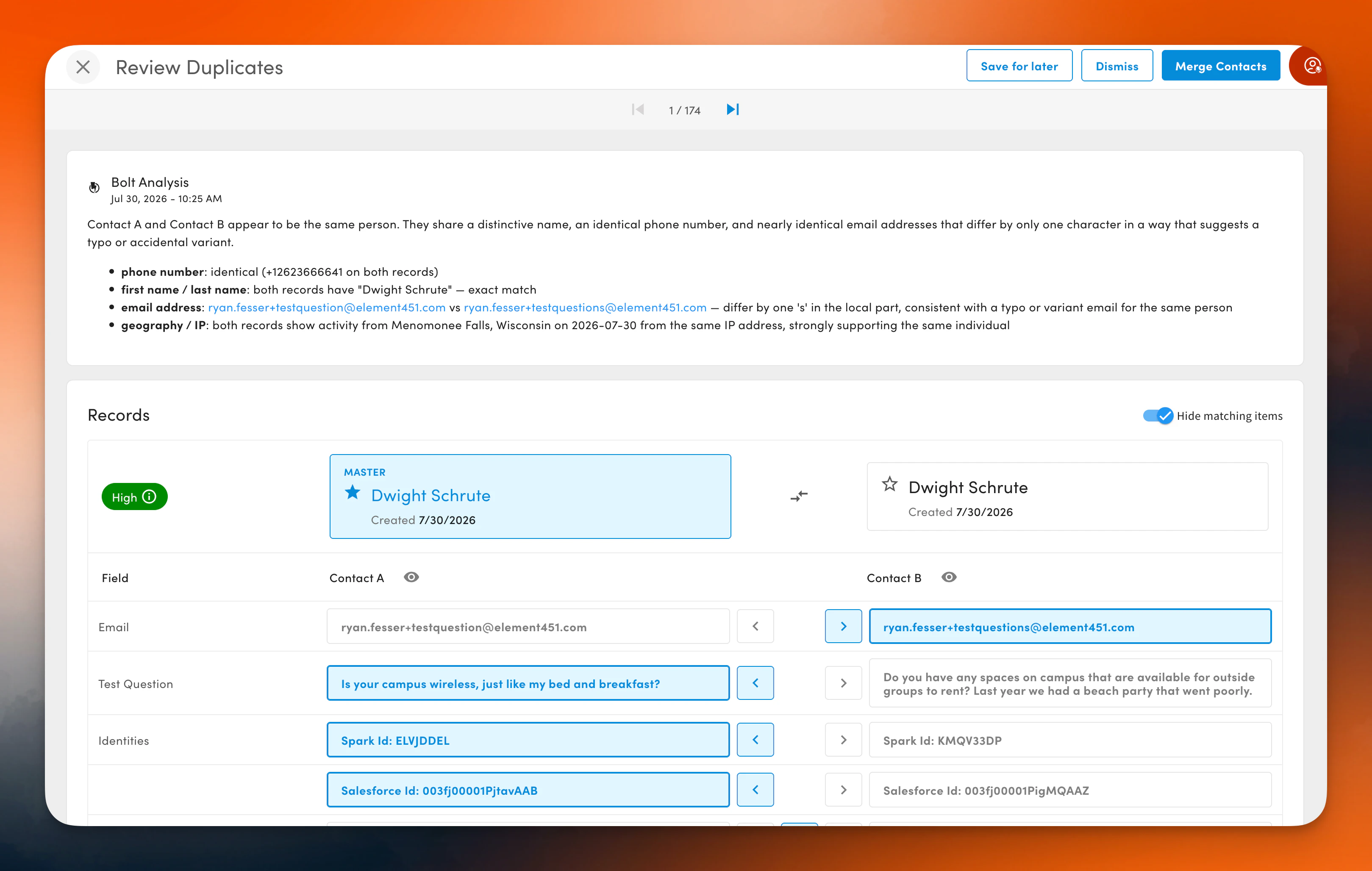
Our new Deduplication experience largely keeps the matching logic that already works, and adds a Bolt-powered analysis layer on top of it. For every likely duplicate pair, staff now see:
- Specific signals that support the match
- Any concerns or conflicting evidence the agent found
- Plain-language reasoning explaining why the pair was surfaced
- A recommended primary record, so staff aren't left guessing which one should stay
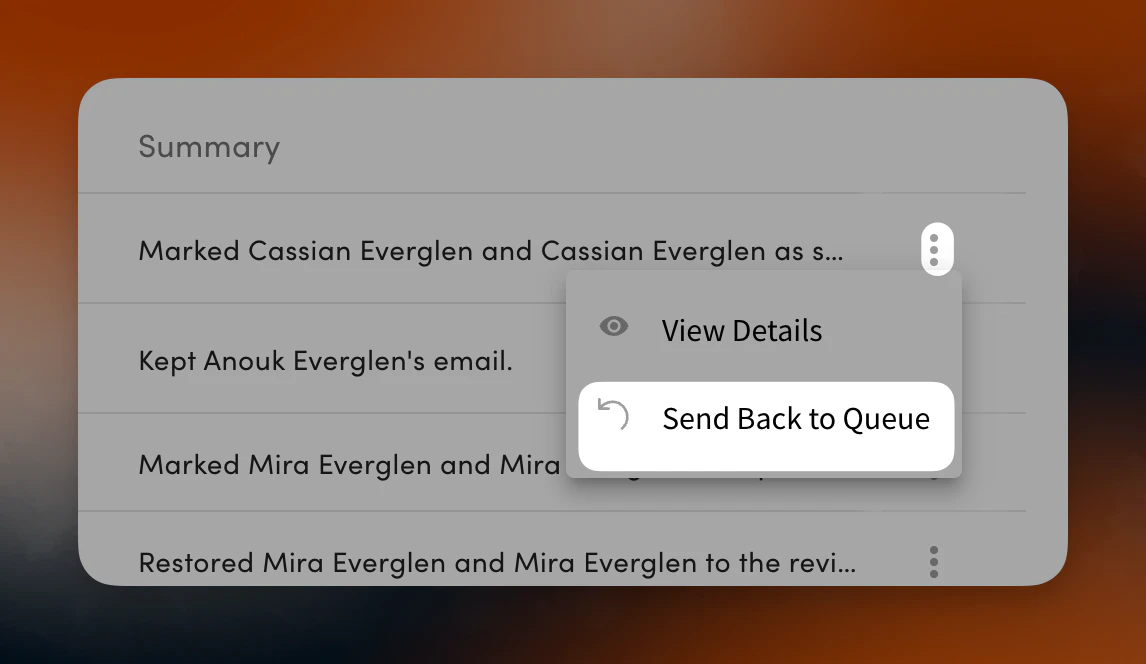
Reviewers can compare records side by side, merge with field-level control over which values survive, or ignore a pair that turns out to represent two different people — all with the same permissions and safeguards the merge process already has today.
Cleaner contact data, with reasoning you can review and decisions you control.
That line has become our shorthand for what this release is really about. The agent identifies duplicates faster and streamlines the review process because staff are evaluating a documented case instead of a bare score. In my experience, that's the difference between a record that takes three to five minutes to resolve and one that takes thirty seconds, because the reasoning is already laid out: this is the older source, that's the conflicting field, here's what we recommend and why.
Bulk Merge, Built for Backlogs
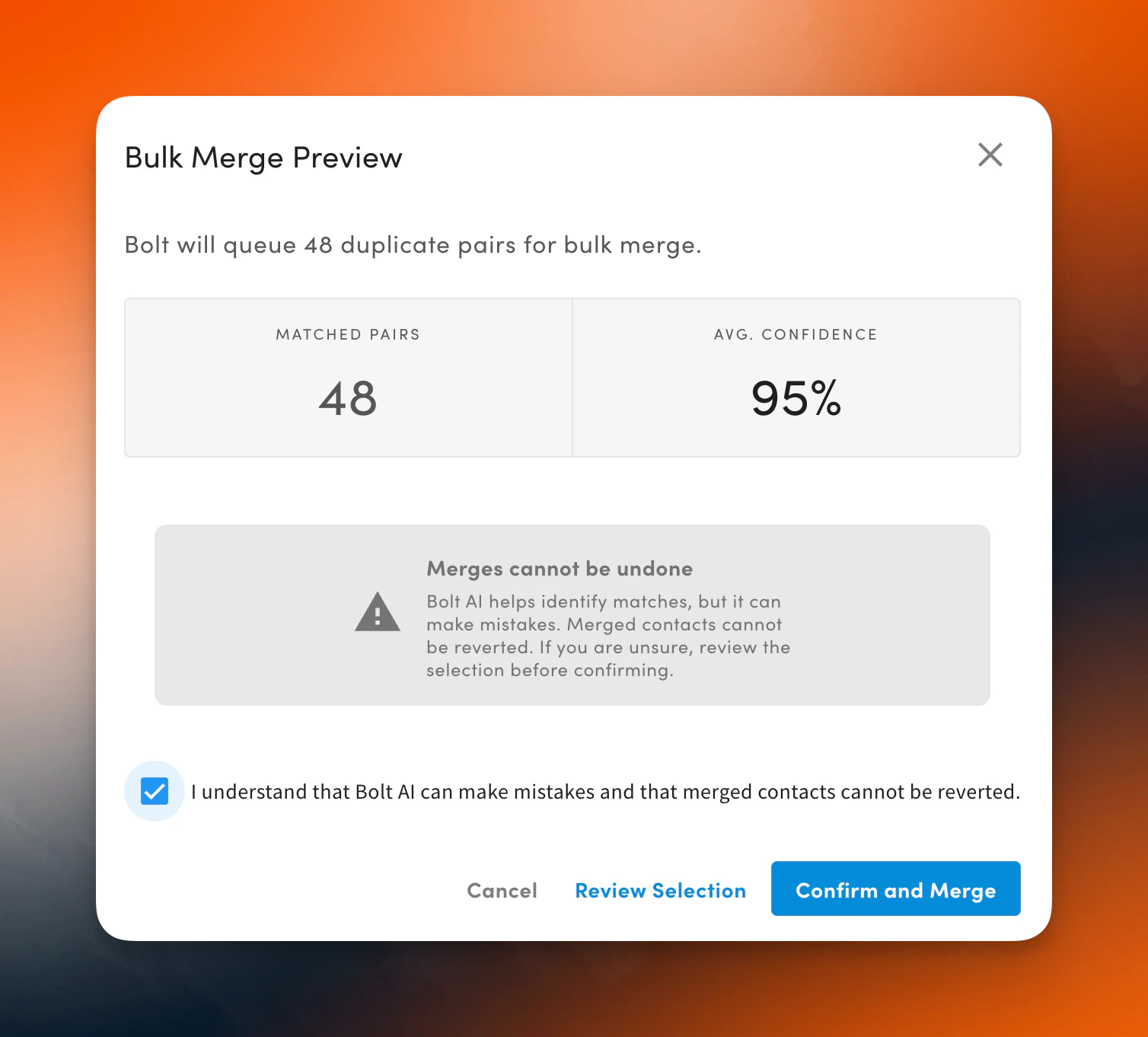
The other piece institutions have been asking for is a way to clear backlogs without reviewing every pair one at a time. Bulk Merge lets staff filter down to a set of similar duplicates, select them as a group, and review the agent's confidence before merging — all in a single, staff-triggered action. If the agent is only 70% confident, that's a signal to slow down and review individually. If it's 95% or higher, that's a group you can move through quickly and safely. Bulk Merge is a guided batch action, not autonomous merging — the decision to run it still belongs to your team.
Where to Start If You're Sitting on Thousands of Duplicates
If your institution has a backlog measured in the thousands, the advice I'd give is the same advice I'd have wanted a decade ago: start with the most recent activity first. A duplicate that's been sitting untouched for three years, with no new activity on the record, is rarely the one costing you the most right now. This release includes filtering capability by Confidence Level, AI Verdict and several Date parameters such as Created, Updated and Analyzed, so you can prioritize instead of treating the backlog as one undifferentiated pile. You don't have to feel the pressure to resolve four-year-old duplicates the same day you tackle this term's queue.
Human in the Loop, By Design
We built this release to be deliberately human-in-the-loop. There's no proactive, autonomous auto-merge in this version. That’s a high-risk capability. We want to earn the right to ship safely, with more testing and controls, before it runs unsupervised on large duplicate queues. For now, the agent recommends and explains; your staff decide. Every merge and ignore action is logged in deduplication history, so admins can audit what happened and why.
Deduplication is included with Bolt Agents across all Bolt and Element solutions.
Why This Matters Now
Contact data quality is the foundation everything else sits on. Every personalized email, every segmentation, every AI agent making a judgment call about a student relies on the assumption that the record it's looking at is complete and correct. Duplicate, fragmented data undermines all of it quietly, until a student notices before you do.
I spent years doing this work by hand, so I don't take lightly what it means to hand staff a tool that explains itself instead of asking them to trust a black box. That's the bar we held ourselves to with this release, and it's the bar we'll keep holding ourselves to as this feature evolves.
Talk to Us to see Deduplication in action for your institution.
About Element451
Boost enrollment, improve engagement, and support students with an AI-driven CRM and agent platform built for higher ed. Element451 makes personalization scalable and success repeatable.

About Element451
Element451 is the AI platform that moves every student forward. Element AI CRM and the Bolt Agent Platform take action across the student journey, from prospect to success. More than 400 institutions use Element451 to drive better enrollment and student outcomes.
Categories
New Blog Posts



The Definitive Guide
AI in Higher Education
Bridge the gap between the latest tech advancements and your institution's success.
Useful Links


Talk With Us
Element451 is an AI-driven CRM and AI agent platform for higher education. Our friendly experts are here to help you explore how Element451 can improve outcomes for your school and students.
Get a Demo