Your campus probably isn't short on software. But even with ample software, a lack of capacity to deploy, act, and implement leaves enrollment teams in the lurch.
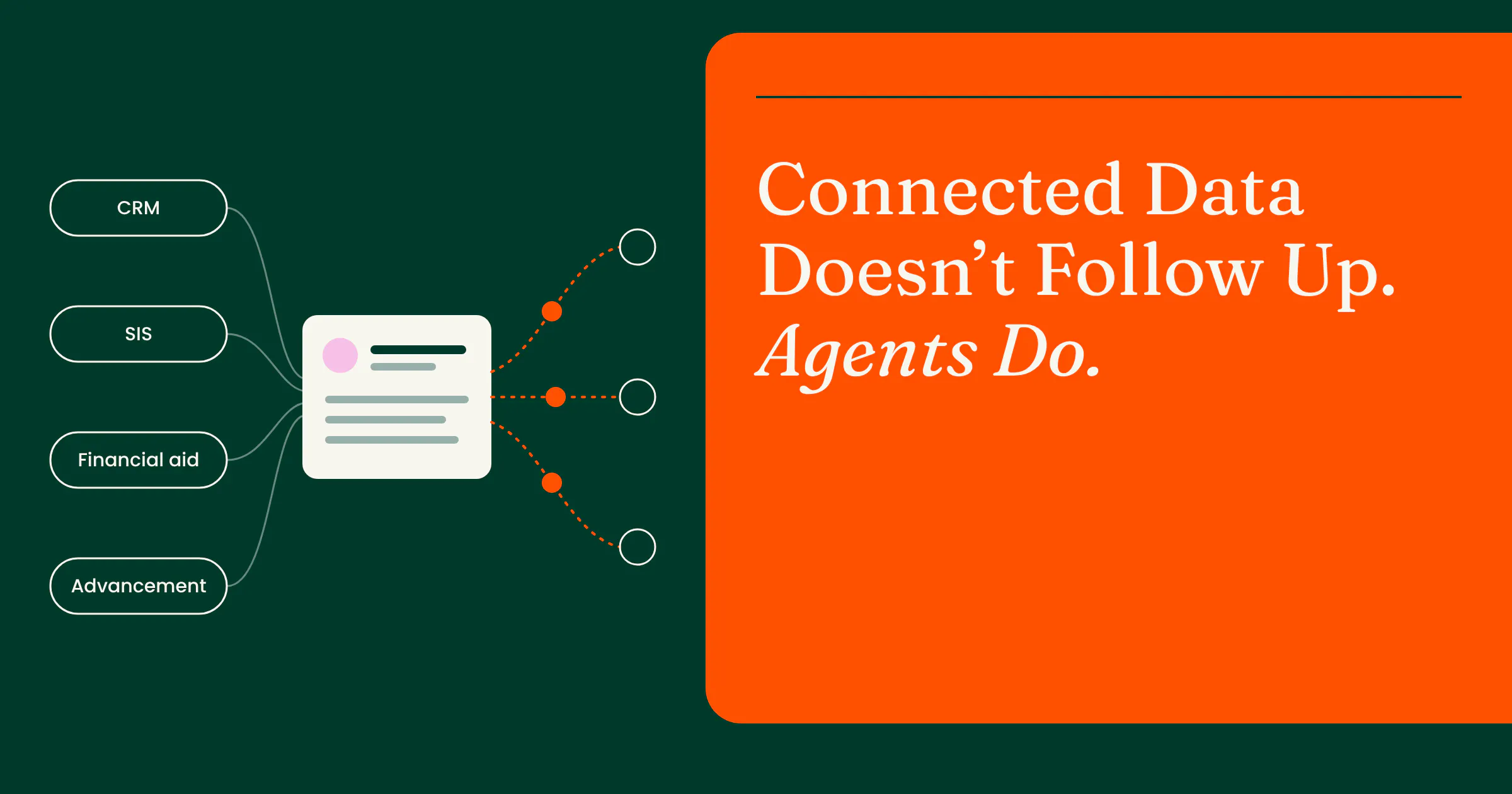
Your customer relationship management (CRM) system holds the prospect. Your student information system (SIS) holds the student. Financial aid, scholarships, and advancement each hold their own piece. Every handoff between them loses something. Sometimes it's data or staff time. Sometimes it's the student.
That's the problem the Connected Campus ecosystem was built to solve, and Element451 recently joined it alongside Blackbaud, Student First, and Doctums. But connecting systems is the first step. Connected data still needs something to act on it.
What Does a Disconnected Campus Actually Cost?
Many campuses didn't build their tech stack with scalability in mind. They built it one purchase at a time. Each system was bought, implemented, and supported on its own, and nobody owned how the pieces fit together.
The costs show up in four places.
A broken record
The prospect, the applicant, the student, and the donor live in different databases. No one sees the whole person. Admissions knows what a student asked about. The registrar knows what they enrolled in. Years later, advancement starts from a name and a class year.
Duplicate work and spend
Overlapping licenses, separate implementations, and separate admins add up fast. Then come the integrations between every pair of systems. And when a student moves from one office to the next, someone types the same data in again.
Slow, risky go-lives
Every new system brings another project plan and another implementation team. Your institution carries the integration risk. When something breaks between two systems, it's not always clear who owns the fix.
Staff stuck doing the follow-up
This is the biggest cost. Teams can't follow up with every prospect or reach every student at risk. More dashboards don't help. They tell your team what needs doing, and your team still has to carve out time to do it.
Why This Can't Wait
Three pressures make the gap harder to live with. There are fewer students to reach. WICHE projects that the number of U.S. high school graduates peaked in 2025 and will fall about 13% by 2041 (WICHE, 2024), so every prospect matters more. Teams are stretched, too. One in four higher ed employees say they're likely to look for another job in the next year, and more than half are at least somewhat likely to leave (CUPA-HR, 2025). And AI-generated fraud now reaches from applications to financial aid.
The U.S. Department of Education's Office of Inspector General has investigated more than $350 million in ghost student fraud over five years, and it's harder to catch when each office sees only its own piece of the student.
Step One: Connect the Systems
The foundation is a shared student record. That's what the Connected Campus ecosystem provides. Blackbaud and Student First set out to connect student, financial aid, scholarship, advancement, finance, and tuition payment data, so departments that have long worked apart can share one view. Doctums designs and deploys it as one solution with one team.
With a shared record, admissions, the registrar, financial aid, and advancement finally see the same student.
Step Two: Put Agents to Work on That Record
For years, campus software tracked the work while people did it. Now AI can take action, too. That's the role Element451 plays in the Connected Campus. Bolt agents build on the shared record and work the student journey alongside your team, taking on the follow-up so staff can focus where they're needed most.
- Prospects. Agents answer every inquiry, personalize outreach, and keep prospects moving toward an application, day or night.
- Applicants. Agents check in on incomplete applications, summarize files, and evaluate transcripts, so no application waits for a first read.
- Current students. Agents watch for early signs of risk and reach out before a student drifts.
Staff keep final ownership of every admissions, financial aid, and fraud decision. Agents do the work. People make the call.
You don't have to start over to get there, either. Institutions can run Element AI CRM, or add Bolt agents to the CRM they already have.
Five Questions to Ask Before You Connect Your Campus
Connecting your systems may seem daunting, but it doesn't have to be. These questions look past the integration diagram to what changes for students and staff.
- Who acts on the data once it's connected? If the answer is "our staff," you've connected the data but not the capacity.
- Does your AI do the work, or just suggest it? A chat window or a dashboard still leaves the follow-up to your team. Look for agents that act.
- Who keeps the decisions? Agents should handle outreach, follow-up, and routine review. Admissions, financial aid, and fraud decisions should stay with people.
- Do you have to replace what works? You should be able to keep the CRM you run today and add agents alongside it.
- Who owns deployment? One plan and one team beat separate go-lives that leave the integration risk with you.
See Agents Work on a Connected Record
Get a first look at how Bolt agents proactively follow up with prospects, read applications, and reach students before they drift, alongside the systems your campus already runs.
Get a Demo