Element451 and Socure Take On Ghost Students With Bolt Fraud Detection and Resolution
Oct 01, 2026

Element451 this week announced Bolt Fraud Detection and Resolution, an agentic product built with Socure that will help institutions stop ghost students and resolve suspicious applications before financial aid goes out the door. The product pairs Socure's identity verification technology with Bolt AI agents, giving fraud detection in higher education a clear path to a documented staff decision.
Most fraud tools stop at the flag. Bolt Fraud Detection and Resolution will keep going, with AI agents handling verification and follow-up while staff keep the final call.
What Is a Ghost Student?
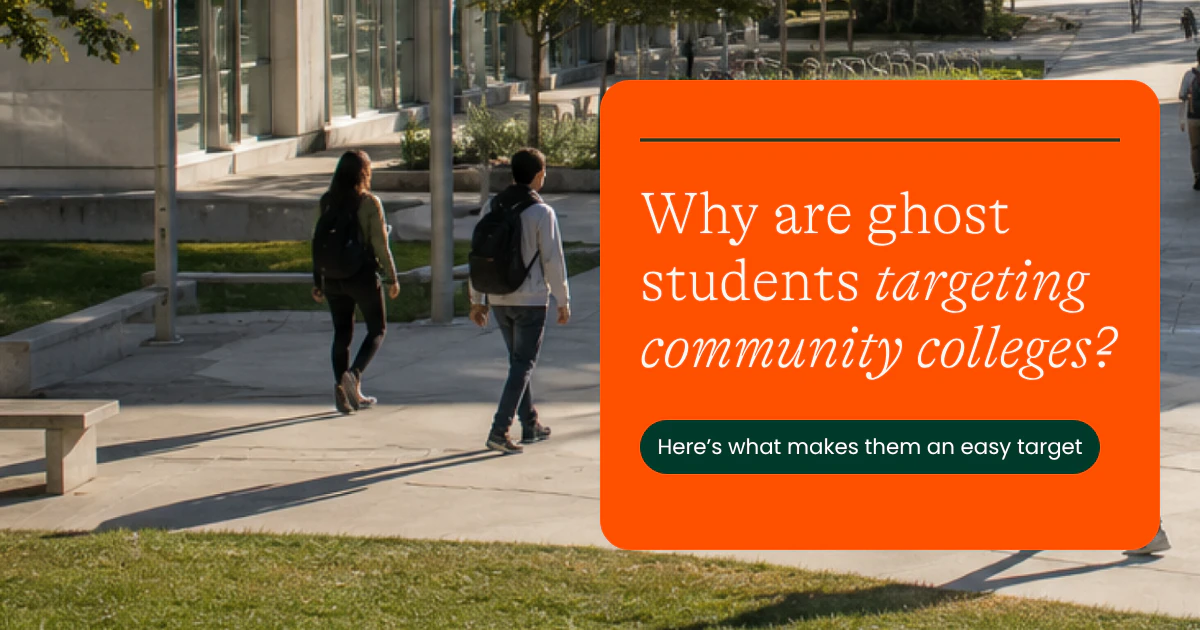
A ghost student is a fraudster who uses a stolen or fabricated identity to apply to college, enroll in classes, and collect financial aid before disappearing. Fraud rings now run these schemes at scale, using AI to generate applications, submit coursework, and keep fake students enrolled just long enough to trigger a refund.
The losses add up fast. The U.S. Department of Education's Office of Inspector General has investigated more than $350 million in ghost student fraud over the past five years, with more than 200 investigations still open. The Department also found nearly $90 million in aid disbursed to ineligible recipients, including $30 million sent to people who had died. In California alone, community colleges reported losing about $10 million in federal aid and $3 million in state aid to fraud in 2024.
Money is only part of the damage. Ghost students take seats in high-demand courses, push real students onto waitlists, distort enrollment data, and use institutional email addresses to run other scams. And every ghost student scam has a real victim whose identity the fraudster stole.
Why College Application Fraud Outpaces Manual Review
Most institutions fight college application fraud with systems built to flag suspicious records. To catch as much fraud as possible, teams often tune those systems wide, which means they catch legitimate students too. A real applicant can end up delayed or blocked from registering or receiving aid.
Once a flag goes up, the hard part begins. Staff chase evidence across disconnected systems, track down applicants for verification, and document a decision, often while the case bounces between offices with no clear owner. For teams already stretched thin, that gap between detection and resolution is where fraud slips through and where real students get stuck.
How Bolt Fraud Detection and Resolution Will Work
Bolt Fraud Detection and Resolution will give admissions, enrollment, and fraud-review staff one coordinated workflow built around four stages.
Screen. Socure's predictive models will work alongside Bolt agents' contextual assessment to screen every applicant.
Verify. When something looks off, Bolt will use Socure's identity verification technology, combined with Element451's proprietary techniques, to verify the record. If a case needs a second look, staff can request a live video appointment to confirm identity, with every earlier attempt kept on file.
Review. Evidence, reasoning, and verification history will live in one shared workspace that staff can export to other platforms as needed.
Decide and document. AI agents will follow up, coordinate verification requests, and escalate cases that need human review. Staff will always make the final fraud determination, along with any admissions or financial aid decision, and the system will document every outcome.
The work won't stop at enrollment. When Bolt detects unusual activity or changes to a student's data later on, it will use Socure's technology to assess the risk and take action in coordination with staff.
Institutions won't need to replace anything to get started. Bolt Fraud Detection and Resolution will run on an existing CRM, whether that's Element451 or another platform, connect to a current SIS through a managed two-way integration, and work alongside an external fraud tool already in place.
Why Socure
The U.S. Department of Education uses Socure's identity technology to secure the FAFSA process nationwide, and Socure's platform can verify up to 98% of applicants. Its fraud models target patterns common to ghost students, including high-risk emails, repurposed phones, high-risk digital traffic, and coordinated fake identities across applications.
See Bolt Fraud Detection and Resolution in Action
Get a first look at how Bolt agents screen, verify, and resolve suspicious applications while your staff keep the final call. We'll walk you through a demo built around how your team reviews fraud.
Get a Demo
Early Results in Financial Aid Fraud Detection
Institutions using Element451's existing fraud detection capabilities already see results. At Galveston College in Texas, the platform flagged more than 1,100 potentially fraudulent applications out of more than 6,200 received in just over a year. Nearly 90% of those flags held up as fraudulent on review.

"Before Element451, we were manually combing through applications trying to spot inconsistencies, like a birth date that didn't line up with a high school graduation year, and I'm sure we missed a lot of fraud in the process," said Scott Branum, Director of Admissions and Registrar at Galveston College. "Now we catch it early and can act with confidence. Without that, we'd likely be finding these cases too late, after financial aid funds were already gone."
Bolt Fraud Detection and Resolution will build on that foundation, adding identity verification and agent-led follow-up to the detection work Galveston's team already relies on.
Why Fraud Detection in Higher Education Can't Wait
Three shifts make this the moment to act. First, AI has made fraud cheaper and faster to scale. In July 2026, the Treasury Department's Financial Crimes Enforcement Network warned financial institutions about schemes using stolen identities, paid "straw students," and corrupt insiders to drain federal student aid.
Second, federal scrutiny is rising. In June 2026, the House passed the No Aid for Ghost Students Act, and a Senate companion bill now sits before the HELP Committee. The legislation would codify a fraud-screening initiative the Department of Education has already started, applying to FAFSAs submitted on or after October 1, 2026. Under it, institutions would need to verify a flagged student's identity before disbursing aid.
Third, institutions can't hire their way out. Verification work lands on the same admissions and financial aid staff already managing growing caseloads. A process that ends at the flag leaves them holding every unresolved case. Agent-led follow-up with a documented outcome gives them a way to keep up and a record they can stand behind.
Talk With Our Team
Bolt Fraud Detection and Resolution is coming soon. Admissions and enrollment leaders can connect with our team to talk through how it fits their fraud strategy, or stop by Element451 at EDUCAUSE for a first look.
About Element451
Element451 is the AI platform that moves every student forward. Element AI CRM and the Bolt Agent Platform take action across the student journey, from prospect to success. More than 400 institutions use Element451 to drive better enrollment and student outcomes.
Categories
New Blog Posts


The Definitive Guide
AI in Higher Education
Bridge the gap between the latest tech advancements and your institution's success.
Talk With Us
Element451 is an AI-driven CRM and AI agent platform for higher education. Our friendly experts are here to help you explore how Element451 can improve outcomes for your school and students.
Get a Demo