How to Buy AI in 2026: A Sourcing Playbook for Higher Ed
Updated Oct 01, 2026
The problem in higher ed isn't a shortage of AI options. It's that most institutions don't know how to buy them. At Engage Summit 2026, we broke down a practical framework for getting it right. Here's what you need to know.
Walk any vendor hall at a higher ed conference right now and you'll feel it immediately. Dozens of companies, all claiming to be the AI solution your institution needs. Every demo looks polished. Every pitch sounds urgent. And somewhere back on campus, there's probably a board mandate to "do something about AI" sitting in your inbox.
The pressure to buy is real. The clarity on what to buy — and whether you're actually ready to — is harder to come by.
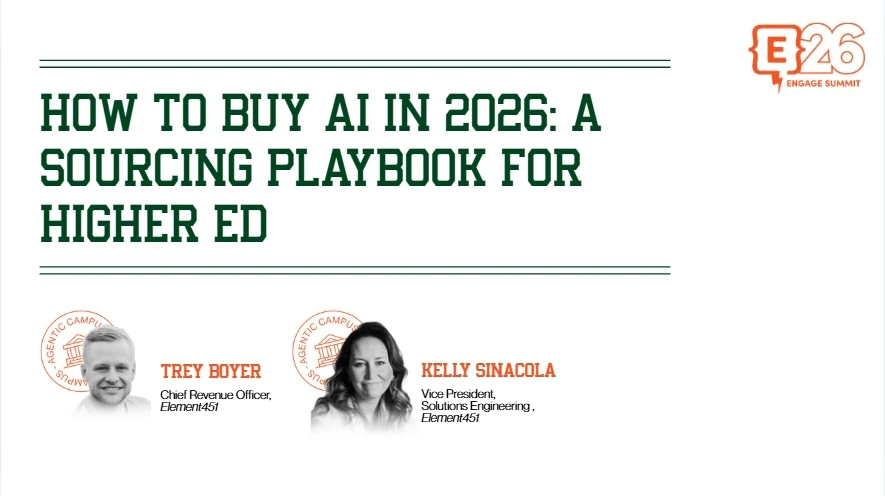
At Engage Summit 2026, Element451 Chief Revenue Officer Trey Boyer and Vice President of Customer Strategy and Technology Kelly Sinacola sat down with a room full of higher ed leaders to work through exactly that. Not another AI strategy conversation. A practical, no-nonsense framework for navigating AI procurement,so institutions stop getting demoed into confusion and start getting real value.
This is a recap of what they covered. The full session is available on-demand at Engage Digital Summit.
You're Not Losing on AI Strategy. You're Losing on AI Procurement.
Most institutions frame the AI challenge as a strategy problem. More vision. Better roadmaps. More executive alignment. But that's not where things are actually breaking down.
The gap between buying AI and getting value from it is where most organizations quietly fail. The buying process itself is broken, and a few things are driving it.
The market is flooded. The barrier to entry for spinning up a convincing AI product has never been lower. A non-technical person with a weekend and the right tools can produce a demo that looks enterprise-ready. Three questions deep, it falls apart. But by then, you've already seen the shiny buttons.
Demos don't reflect deployment. What you see in a controlled, curated environment almost never mirrors what happens when real data, real workflows, and real staff are involved. The gap between demo and deployment is where projects go to die.
Tools don't integrate. AI is being layered on top of systems that were never designed to talk to each other. Data is siloed, inconsistent, or locked behind legacy infrastructure. And even when the technology works, teams don't always change their workflows to use it.
That last point matters more than most procurement conversations acknowledge. Research suggests that roughly 70% of the impact of any AI initiative isn't about the algorithm or the software. It's about the people, the process, and the change management surrounding it. You can buy the right tool and still fail completely if the organization isn't ready.
Define the Job Before You Talk to a Single Vendor
The most important shift isn't about vendor selection. It's about what happens before vendor selection.
Before you respond to an email. Before you schedule a demo. Before you send anyone to a conference to look at options. Define the job you're hiring AI to do.
Not the high-level vision. The concrete, specific job. What metrics are you trying to move? By how much? In what timeframe? Most institutions skip this entirely and go straight to evaluation mode. The result is impressive demos solving the wrong problem beautifully.
It also helps to be clear about what kind of solution you actually need, because AI, automation, and agents aren't the same thing.
Automation is rigid. It follows rules, does exactly what you configure it to do, and breaks when conditions change. AI tools are smarter but often disconnected. They're good at specific tasks but don't coordinate across your systems. Agents are different. They act across systems, apply judgment, handle ambiguity, and coordinate tasks. If the job you're hiring for requires weighing options, handling exceptions, and adapting to context, you need an agent, not a workflow trigger.
Understanding where a vendor sits in the technology stack matters too. Infrastructure vendors like OpenAI or Anthropic give you models and compute to build on. Application tools like Copilot are built on that infrastructure and solve specific use cases. Embedded AI is baked directly into tools you already use, like Salesforce Einstein or Notion AI.
Knowing which category you're buying changes what you're responsible for building yourself, what the real cost looks like, and what happens if something breaks.
A simple test: if you remove the AI from what a vendor is selling, what's left? If the answer is nothing, AI is the product. If the model improves, you benefit. If it breaks, you're stuck. If something remains, you're buying an app or a platform with an AI layer. Neither is wrong, but you need to know which one you're signing up for before you sign anything.
Are You Actually Ready to Buy?
This is the question most organizations skip. And often the most important one.
Most failed AI projects aren't technology failures. The vendor delivered. The model performed. The analytics looked fine. But the organization wasn't ready, and the project quietly died anyway. A 2025 MIT study found that roughly 90% of AI pilots are currently failing to reach the point of driving real value.
Readiness isn't about whether procurement can issue a purchase order. It's about whether the organization can actually absorb and use what it's buying. Five questions to answer honestly before moving forward:
Who owns AI decisions? Is there a clear decision-maker, or will this stall in committee indefinitely? If the answer is "IT blocks it," is there a governance framework, or just a default to no?
Can AI access your data? Is your data clean, accessible, and permissioned correctly? If the honest answer involves phrases like "don't look in there" or "that's a mess," you have pre-work to do.
Do your systems integrate? Not "can they integrate" or "it's on the roadmap." Does the tool connect today to the systems where work is actually happening?
Who owns success internally? Is there a named person accountable for making this work, not just for buying it?
Will your team actually use it? Have the people who will use this daily been part of the evaluation? Their adoption is the only metric that matters long-term.
Trey offered a firsthand example here. Element451 bought an AI product that he, by his own admission, fell in love with in the demo. They implemented it. The team didn't use it. Nobody was logging in. They cancelled it. The framework they were presenting to the room was, in part, the one they wished they'd followed themselves.
Once readiness is confirmed, success needs a definition that's specific enough to measure. Not "improve engagement." Something more like: reduce time-to-response from four hours to 30 minutes within 90 days. Baseline, target, timeframe. If you can't define success that concisely, you're not ready to buy.
Why Pilots Fail — and How to Run One That Doesn't
Pilots are supposed to de-risk a buying decision. In practice, they often just extend the demo.
The pattern: a vendor shows a polished, curated demo. Everyone's impressed. A pilot gets approved. It runs on clean data, a narrow scope, with humans still in the loop. Results look great. Then real data enters the picture. Scope expands. Staff step back. The system starts to break down.
A pilot without defined success criteria is just a longer demo. The MIT data backs this up: most pilots fail because success was never concretely defined, and then scope creep takes over until the whole thing collapses under its own weight.
The fix is to shrink the scope deliberately. Pick one or two metrics. Use real data. Set a real timeframe. Resist every pressure to expand what you're testing before you've proven the core use case works. You can grow from there. You can't un-creep a scope that got away from you.
When evaluating vendors, three questions cut through most of the noise. Does it actually integrate with your systems today, not theoretically? Will your team genuinely use it, based on their input, not your assumptions? And what is the real cost to run it, including implementation, training, maintenance, data prep, and internal time? License fees are the beginning of the conversation, not the end. For AI products specifically, ask about usage costs and token costs as adoption grows. Get the answers in your terms and conditions. If a vendor pushes back on that, it's a red flag.
The Higher Ed RFP Toolkit
If you're building out your RFP process, Element451's Higher Ed RFP Toolkit walks through how to craft better questions, evaluate vendors, and structure the selection process from start to finish. It's a practical companion to the framework covered in this session.
Learn More
The Six-Step Framework
Here's the full procurement framework. The order isn't arbitrary — each step depends on the one before it:
1. Define the problem. Articulate the specific job you're hiring AI to do before talking to any vendor.
2. Confirm readiness. Answer the five readiness questions honestly. Fix gaps before proceeding.
3. Define success. Set a baseline, a target, and a timeframe. No vague goals.
4. Place the vendor in the stack. Understand whether you're buying infrastructure, an application, or embedded AI, and what that means for your team.
5. Run a real pilot. Use real data, real scope, and real success criteria — not a controlled sandbox.
6. Evaluate for adoption. Measure whether your team actually uses it, not just whether it technically works.
Watch the Full Session
This session is available on-demand as part of Engage Digital Summit 2026. Watch it alongside 50+ additional sessions.
About Element451
Element451 is the AI platform that moves every student forward. Element AI CRM and the Bolt Agent Platform take action across the student journey, from prospect to success. More than 400 institutions use Element451 to drive better enrollment and student outcomes.
Categories
New Blog Posts



The Definitive Guide
AI in Higher Education
Bridge the gap between the latest tech advancements and your institution's success.

Talk With Us
Element451 is an AI-driven CRM and AI agent platform for higher education. Our friendly experts are here to help you explore how Element451 can improve outcomes for your school and students.
Get a Demo