Ghost Students Are Targeting Community Colleges. Here's Why.
Oct 08, 2026
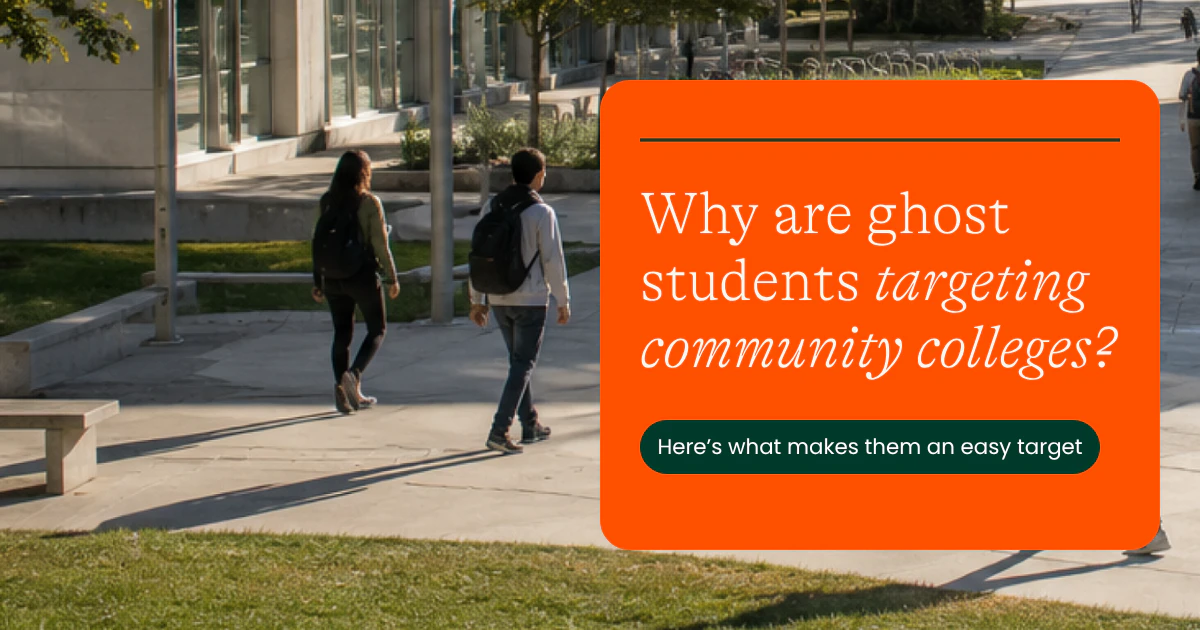
A ghost student is a fake or hijacked identity that a fraudster uses to enroll in college and collect financial aid, with no intention of ever attending. Ghost students target community colleges most because open admission, free online applications, and large online course catalogs enable fraud rings to apply at scale without anyone setting foot on campus.
The scale has grown fast. California's community college system publishes more fraud data than any other, and its officials flagged 31.4% of roughly 2 million applications as fraudulent in 2024, up from 20% the year before. The same pattern is showing up in Minnesota, Washington, Texas, and beyond. Here's how the scheme works, why two-year colleges sit at the center of it, and who pays when it succeeds.
What Is a Ghost Student?
A ghost student exists only on paper. Sometimes the identity belongs to a real person who has no idea a fraudster took it. Sometimes it's synthetic, stitched together from real and invented details. Either way, no one behind the record plans to learn anything. The goal is money, usually a federal Pell Grant or student loan, and sometimes state aid.
You may also hear the term "Pell runner.," as it describes the same scheme. But what has changed is the operator. Ghost students used to be the work of individual scammers. Today they're more often run by organized rings using bots and AI tools that can generate, submit, and maintain thousands of fake records at once.
How Does Ghost Student Fraud Work?
Most schemes follow the same arc. First, the fraudster gets an identity, either by buying stolen personal data or by building a synthetic one. Next comes the application. Bots fill out free online admission forms in bulk, often across many colleges at the same time. At South Puget Sound Community College in Washington, Enrollment Director Roosevelt Mendez told KUOW that his team has seen fraudsters use AI to submit 30 applications to different colleges within minutes.
Once admitted, the ghost student registers for classes, almost always online. Fraudsters now use AI to post discussion replies and complete coursework so the account looks active long enough to pass attendance checks. Then they file a FAFSA.
The payday comes at disbursement. Aid goes to the college first, which applies it to tuition and fees and sends whatever is left to the student as a refund. Once that refund lands, the ghost student disappears.
Why Do Ghost Students Target Community Colleges?
Fraud rings go where the cost of entry is lowest and the payout is reliable. Community colleges are built to be the most open door in higher education and fraudsters exploit that strength.
Mikki Johnson, Director of Financial Aid at Fresno City College, told ABC30 that fraudsters target community colleges because they are open-access institutions, without the rigorous admissions requirements many four-year universities have.
Free Applications With Few Identity Checks
Many community colleges dropped application fees to welcome first-generation students and adults returning to school. Karl Smith, Vice President of Student Affairs at Tacoma Community College, told KUOW that lowering those barriers is part of why fraudsters target two-year colleges. In California, the statewide CCCApply application is free, and applicants can decline to provide a Social Security number. Those choices help real students. They also let a fraud ring submit thousands of applications at no cost.
Online Courses Mean No One Has to Show Up
Distance learning exploded during the pandemic, mainly at open-access community colleges, and remote classes made it far easier to impersonate students. Dr. Beatriz Chaidez, Chancellor of the San Jose-Evergreen Community College District, told ABC7 News that she sees the most fraud in asynchronous online courses, where students work at their own pace and never meet an instructor face to face.
Low Tuition Leaves More Aid to Take
Because aid covers tuition first and the balance goes out as a refund, a low-cost college leaves more of each award available as cash. The same affordability that makes community colleges a lifeline for real students makes them a better return for fraudsters.
Bots Move Faster Than People
A real applicant can spend 25 minutes to an hour on California's statewide application, according to guidance from North Orange Continuing Education. A bot needs seconds. Michael Fink, Chief Technology Officer at Chaffey College, told Fortune that his team has seen 50 applications arrive within two seconds, and every seat in a 36-seat class taken within the first minute of registration.
How Big Is the Ghost Student Problem?
No national count exists. California and Minnesota publish the clearest data, and federal figures come from investigations rather than a full census.
Figure | Period | Source |
|---|---|---|
31.4% of ~2 million California community college applications flagged as fraudulent (up from 20% in 2023) | Calendar 2024 | CA Community Colleges Chancellor's Office, via San Francisco Chronicle |
More than $10 million in federal aid and $3 million in state aid lost to fraud in California | March 2024 to March 2025 | Chancellor's Office, via CalMatters |
About $5.5 million in federal aid and $900,000 in state aid lost in California | January to March 2025 | College reports to the Chancellor's Office, via CalMatters/KALW |
About $1.5 million in federal aid and $330,000 in state aid lost in California | Spring 2026 | College reports to the Chancellor's Office, via CalMatters/KALW |
7,715 aid applications flagged as fraudulent or potentially fraudulent across Minnesota State, falling to 2,696 | 2024–25, then 2025–26 | Minnesota State, via KAXE |
More than $350 million in ghost student fraud investigated nationally, with 200+ open investigations | Five years through January 2026 | U.S. Department of Education OIG, via ABC NU.S. Department of Education OIG, via ABC Newsews |
Two things stand out. The share of suspect applicants in California kept climbing, reaching about a third by spring 2025. And losses dropped sharply once colleges added stronger screening. Detection works when it keeps pace with the fraud.
What Does Ghost Student Fraud Look Like on Campus?
At San Jose-Evergreen, Chaidez described courses with 50 seats filled and more than 100 people on the waitlist. When staff reviewed the roster, she told ABC7 News, maybe six of the enrolled students were real.
At Santiago Canyon College in Orange County, President Jeannie Kim told Fortune that fraudulent accounts filled waitlists and classrooms during a fall attack, and real students reported they couldn't get into the courses they needed. The college ended up dropping more than 10,000 fake enrollments. By spring 2025, ghost enrollments had fallen from 14,000 at the start of the term to fewer than 3,000.
Who Pays When Ghost Students Get Through?
Real students pay first. When fake accounts fill a section, a working parent or a pre-nursing student who needs that course to stay on track lands on a waitlist, sometimes for a full term.
Identity theft victims pay too. ABC News reported on a Virginia father and his teenage son who tried to apply for financial aid and discovered accounts already existed in both their names, tied to applications at multiple community colleges. Some victims only learn about it when they're told they owe the Department of Education money.
Colleges and taxpayers absorb the losses. In Minnesota, at least three Minnesota State colleges paid back between $9,500 and $63,457 to the federal government after ghost students collected aid.
Staff and faculty pay in time as well. California Community Colleges Chancellor Sonya Christian has said bot-hunting costs faculty hours they could spend supporting students. And fake enrollments distort the data colleges use to plan sections, staff classes, and forecast funding, often inflating demand that disappears weeks later.
What Are Colleges and the Federal Government Doing?
In June 2025, Federal Student Aid expanded identity verification, giving institutions in-person and live video options to confirm a flagged student's identity. On April 26, 2026, FSA added real-time identity fraud screening inside the FAFSA, sorting every applicant into one of four risk categories as they complete the form. A month later, it published best practices for institutions, including layered verification for higher-risk cases.
Where Element451 Fits
Detection only helps when staff can act on it. Element451's Bolt App Fraud Detector Agent reviews each application against signals like submission timing, duplicate applications, email, IP address, location, and phone data. It assigns a low, medium, or high risk flag with its reasoning, and staff decide whether a record is fraudulent or legitimate. At Galveston College in Texas, it flagged more than 1,100 of over 6,200 applications in just over a year, and nearly 90% held up as fraudulent on review. "Now we catch it early and can act with confidence," said Scott Branum, Director of Admissions and Registrar.
Coming soon, Bolt Fraud Detection and Resolution will extend that work with identity verification and agent-led follow-up, while staff keep the final call.
Frequently Asked Questions
What is a ghost student scam?
Why do ghost students target community colleges?
Are ghost students only a problem in California?
How do ghost students get financial aid money?
How can colleges tell a ghost student from a real one?
See What Comes Next
Ghost students exploit the same openness that makes community colleges work for real students. To see how AI agents will carry a flagged case through verification to a documented staff decision, read the full announcement of Bolt Fraud Detection and Resolution.
About Element451
Boost enrollment, improve engagement, and support students with an AI-driven CRM and agent platform built for higher ed. Element451 makes personalization scalable and success repeatable.
Categories
New Blog Posts


The Definitive Guide
AI in Higher Education
Bridge the gap between the latest tech advancements and your institution's success.

Talk With Us
Element451 is an AI-driven CRM and AI agent platform for higher education. Our friendly experts are here to help you explore how Element451 can improve outcomes for your school and students.
Get a Demo