20 New Teammates, Zero New Budget: How Wake Tech Scaled AI Agents Across an Entire Institution
Updated Oct 01, 2026
Wake Technical Community College is the largest community college in North Carolina, serving more than 72,000 students annually across degree and non-degree programs. It is the second-largest provider of undergraduate education in the state. It is also a number that keeps climbing.
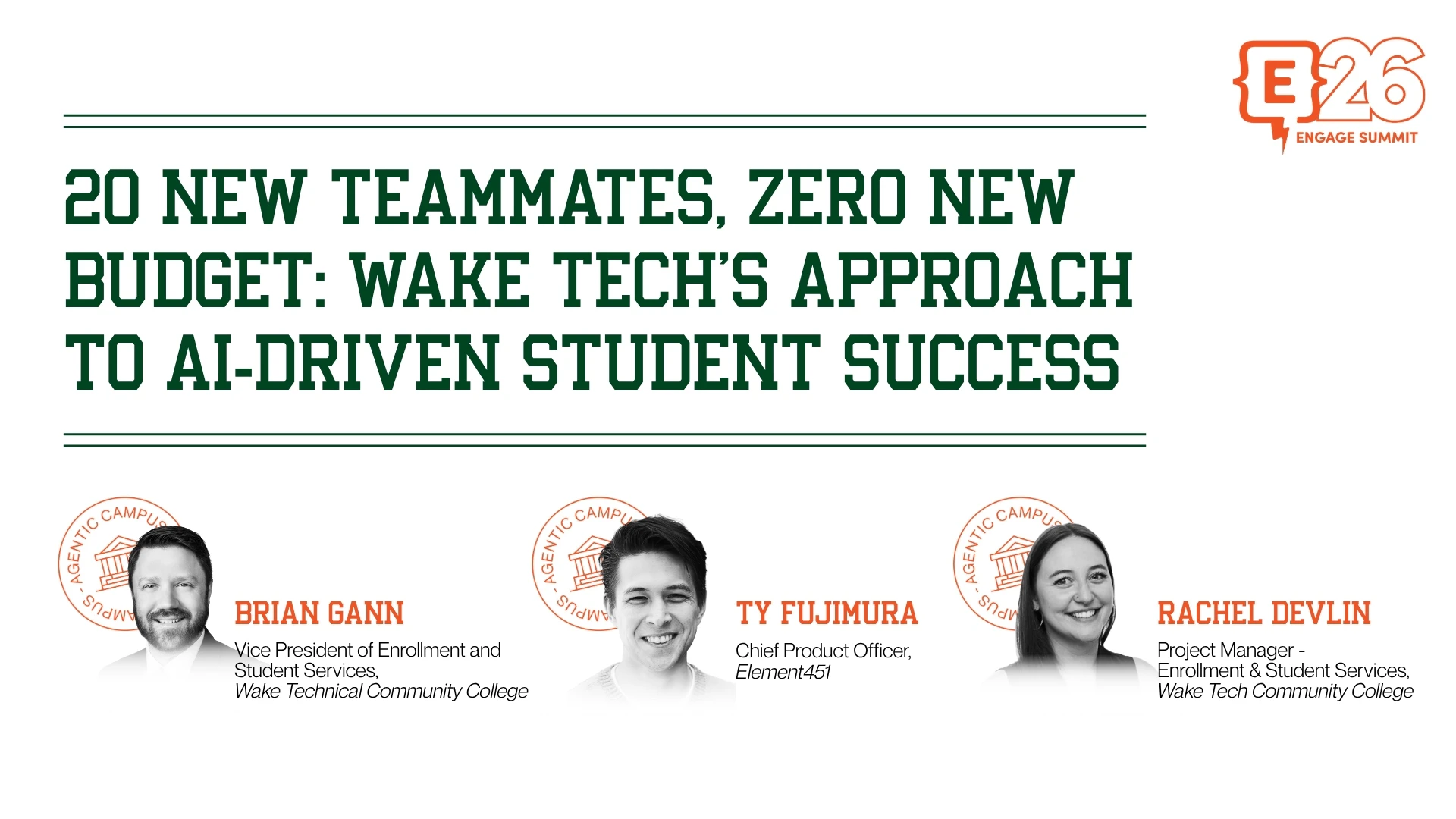
Wake Technical Community College is the largest community college in North Carolina. In a 12-month period, Wake Tech serves 75,000 students across degree and non-degree programs, more than the University of North Carolina at Chapel Hill and NC State University combined. It is a number that keeps climbing.
The math stopped working a long time ago. More students, more channels, more questions after 5pm and before 8am, and staff who were already at capacity. With tighter budgets, hiring more people wasn't the answer. Brian Gann, Vice President for Enrollment and Student Services, knew that. So did Rachel Devlin, project manager for enrollment and student services.
Their answer was 20 Bolt agents live across the institution by Engage Summit 2026. By the time they took the stage, they were already at 21.
At Engage, Brian and Rachel walked through how they got there — the philosophy, the specialization strategy, the mistakes, and what they would tell any institution thinking about doing the same. The full session is available on-demand as part of Engage Digital Summit 2026.
Pilot to Scale, Not Pilot to Decide
Most institutions approach AI with a question: should we do this? Wake Tech approached it differently. The question was never whether to deploy agents at scale. It was how to get there as fast as possible.
Brian calls the philosophy pilot to scale, not pilot to do or not do. The end result was decided. The pilots were there to learn, adjust, and build confidence, not to make the fundamental go/no-go call.
That shaped everything. When they launched Talon, named after Wake Tech's Eagle mascot, they put it on the homepage, the highest-traffic page on the institution's website. Not a quiet corner of the site. Not a test environment. The front door.
The logic was simple. Go where the volume is, learn fast, and build from there. For institutions worried about starting too big, Brian's advice is direct.
"For those that are saying I don't know where to start, the answer is somewhere. Pick a problem that you've got and go. Don't let yourself get caught up in the what ifs and the what abouts. You can't break anything so badly that you can't fix it. So don't let that analysis in your head slow you down too much."
From One Agent to 21
Talon worked. And then Talon started to struggle.
The breaking point was transcripts. At Wake Tech, the word "transcript" means at least five different things. A GED transcript, a workforce transcript, an undergraduate degree transcript, an incoming transcript under evaluation, or a request to order an official copy. Talon had knowledge about all of them. When a student typed a single word, transcript, the agent had too many answers to choose from and kept giving the wrong one.
The fix was specialization. Break the knowledge apart. Move agents into specific parts of the website where the context was already clear. A student on the registrar's page asking about a transcript was almost certainly asking a different question than a student on the admissions page asking the same word.
That logic drove the whole expansion. The "Become a Student" page now has three agents positioned prominently, Talon for general questions, Addison for traditional admissions, and Charlie for dual enrollment high school students. Different knowledge bases, different personalities, designed for whoever is most likely to land on that page. Contact us pages were rebuilt to lead with agents rather than phone numbers and email addresses.
Wake Tech now has 21 named agents live across the institution, in admissions, the registrar's office, financial aid, dual enrollment, continuing education, and the care team advising model that structures their student success work. Each one has a name, a face, a role, and in some cases a dedicated phone number.
Treating Agents Like Teammates, Not Tools
The framing that runs through everything Wake Tech has built is not AI as software. It is AI as staff.
Brian put agents on the org chart. Literally. Wake Tech runs advising, career services, and wraparound support through 14 care teams organized by career field. Each team has a director, advisors, a student success coach, a career coach, and an AI agent. The agent has a name, a phone number, and a defined role. Students can bookmark the agent's number in their contacts.
Reggie, the registrar's office agent, answers inbound phone calls from 5:01pm to 7:59am and all day on weekends. The registrar's phone line no longer goes to voicemail after hours. It goes to Reggie.
"Because we're treating them like teammates, this is part of the org chart. You cannot cuss Reggie out because I wouldn't let you cuss Sheila out who's sitting here from the registrar's office."
Rachel's take on this framing goes beyond culture. Treating agents as teammates changes what you can learn from them.
"I don't learn much from a hammer. The hammer is doing the job that it's set to do. I learn from my teammates and I am learning from these agents every day, what we can do better, what the real questions our students have. I have the data. I am not asking every frontline staff member to share a list of every question they got that day. But I can ask the agents that."
That data is reshaping how Wake Tech thinks about the student experience. When the same question shows up hundreds of times, it is a signal that something upstream is unclear, a form, a web page, a process that could be fixed before students ever have to ask.
What the Numbers Showed
Over nine months spanning a summer and fall registration cycle, inbound calls to Wake Tech's two highest-volume phone lines, the main institution number and the admissions office, both dropped 20%. At the same time, applications were up 19% and enrollment was up 13%.
Calls didn't drop because students stopped needing help. They dropped because students were getting answers from agents instead. The teams handling those lines went from unmanageable volume to a manageable pace.
Bolt Jobs, the proactive outreach sequences agents run independently, have completed more than 1,000 tasks with no human intervention across five active jobs. Rachel's team uses them for admissions funnel reminders, application completion nudges, and specialized program follow-ups that previously fell through the cracks because no one had time to run them manually.
Over the 24 months spanning Wake Tech's agent deployment, full-time equivalent enrollment is up 28%. Brian is careful about attribution. Agents are one part of a broader strategy, not the sole cause. But they are a force multiplier across everything else the institution is doing.
What They Would Tell You
A few things came through clearly in the Q&A that are worth taking back.
Start somewhere. Pick a problem, any problem. The institutions that stall are the ones waiting for the perfect use case or the perfect readiness level. Wake Tech went live on their highest-traffic page first. That might not be right for every institution, but something is right for every institution.
Build champions. Rachel and her colleague Talon are a team of two running CRM and agent implementation for a 75,000-student institution. That is not possible without department-level champions who are willing to jump in, try something, and iterate. Find them early.
The agents teach you. The data coming out of agent conversations is a continuous signal about where the student experience has friction. Review the conversations. Ask what question keeps coming up and why. Sometimes the right answer is a better agent response. Sometimes it is a clearer webpage, a redesigned form, or a process that should have been fixed years ago.
Prepare your managers. Brian ended with a challenge for the VPs, AVPs, and directors in the room. Learning to lead professionals and agents side by side is the next leadership imperative in higher education. It is not a future problem. It is here.
"We are headed into a workforce of more than human beings and we're here. If you're going to think at scale, how do you help your management team and your leadership folks lead professionals and agents on a side-by-side daily basis?"
Watch the Full Session
This session is available on-demand as part of Engage Digital Summit 2026. Watch it alongside 50+ additional sessions at Engage Digital Summit 2026.
About Element451
Boost enrollment, improve engagement, and support students with an AI-driven CRM and agent platform built for higher ed. Element451 makes personalization scalable and success repeatable.
Categories
New Blog Posts


The Definitive Guide
AI in Higher Education
Bridge the gap between the latest tech advancements and your institution's success.

Talk With Us
Element451 is an AI-driven CRM and AI agent platform for higher education. Our friendly experts are here to help you explore how Element451 can improve outcomes for your school and students.
Get a Demo