How Cape Cod Community College Deployed an AI Admissions Agent In One Week, And Kept Its Small College Identity
Updated Sep 29, 2026
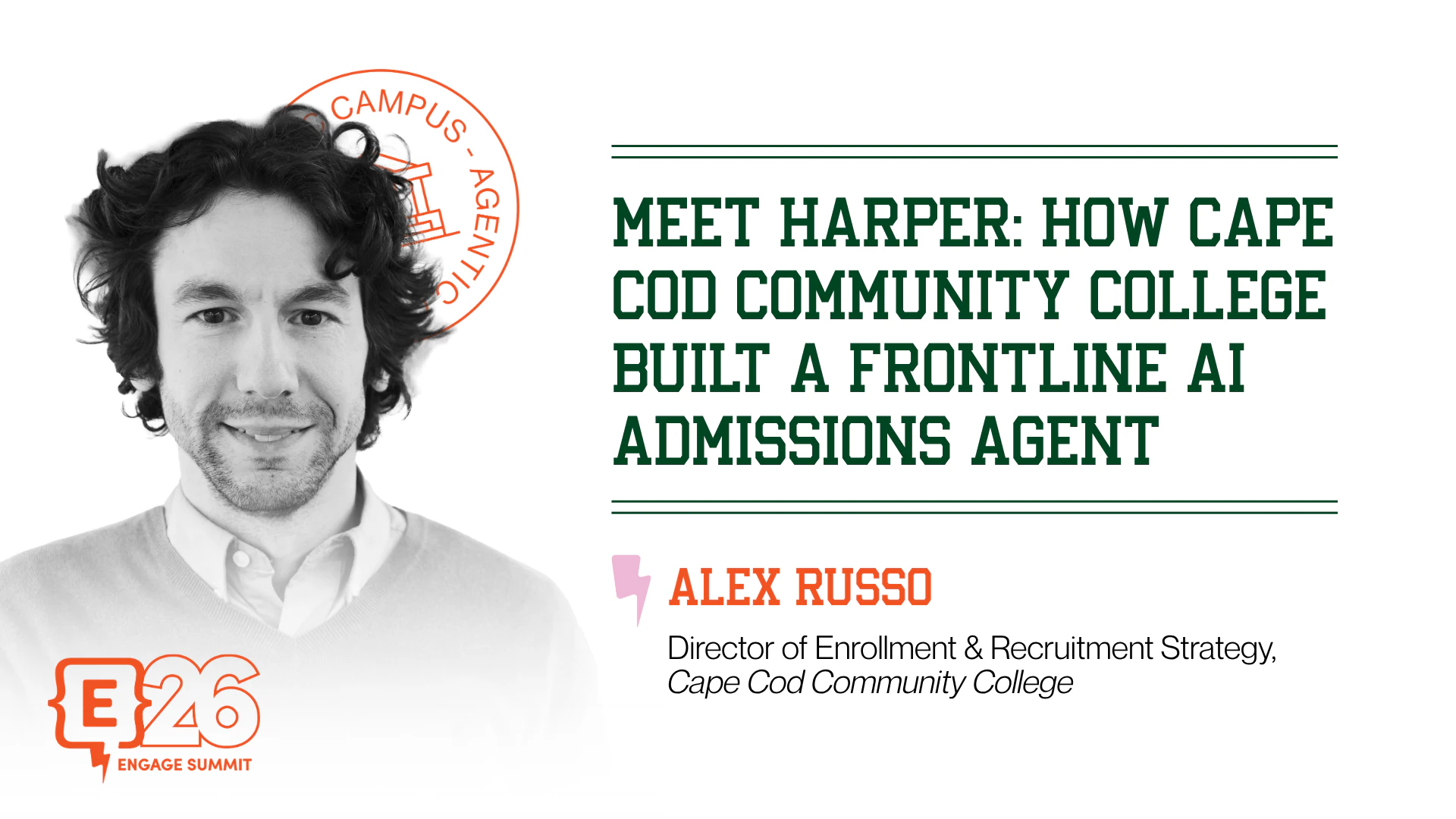
This session aired as part of the Engage Digital Summit 2026 Summer Webinar Series and is now available on demand. It featured Alex Russo, M.Ed., Director of Enrollment and Recruitment Strategy at Cape Cod Community College, known locally as 4Cs.
Cape Cod Community College built its reputation on knowing students by name. Staff remembered who was a single parent, who was the first in their family to consider college, who needed a call after hours instead of an email in the morning. That relational instinct ran deep, and it worked, for a while.
Then Massachusetts rolled out free community college. Applications jumped 40 percent almost overnight. And voicemail boxes filled every morning as inquiries piled up faster than a small enrollment team could respond. At the time, 4Cs was among the roughly 8 percent of institutions in the country still operating without a CRM. Information lived in color coded sticky notes, filing cabinets, and one Excel spreadsheet that only one person fully understood.
The team wasn't failing because they didn't care. They were failing because there weren't enough hours in the day. Students were inquiring at 11pm, expecting a response within two hours, while juggling work, kids, and everything else competing for their attention. A staff working by hand couldn't match that pace, no matter how much intention they brought to the work.
Meet Harper
Cape Cod Community College became the first institution in New England to implement Element451, and the first thing they built was Harper, an AI admissions agent designed to sit at the front door of the enrollment funnel.
Harper handles the high volume, repeatable work that was eating the team's day. Online inquiries. Application status questions. Program requirements. Deadline reminders. Event and appointment registration. Anything that needed a fast, accurate answer around the clock.
Harper hands off anything that needs a person, like financial aid complexity, withdrawals, program changes, and any conversation that carries emotional weight. That division of labor wasn't decided by an algorithm. It came from the team members who already knew which questions needed a human touch and which ones just needed a fast, correct answer.
The clearest way to understand what changed is by looking at a single student. She's 28, works an afternoon shift, and has two kids. The only time she has to think about her own future is after 9pm, once the kids are asleep. In the old system, she might email at 10:15pm and wait two or three days for a reply, by which point her motivation had cooled and life had moved on. With Harper, she inquires at 10:15pm, gets an instant response, and books a campus tour by 10:22pm. She shows up Thursday and enrolls.
Round the clock availability isn't a nice feature on a brochure. For students juggling work and family, it's the difference between showing up and disappearing.
Building Trust Before Building Scale
None of this happened overnight, and Alex was clear that the rollout wasn't seamless. The hardest part wasn't teaching Harper what to say. It was earning the team's trust that Harper would say the right thing when no one was watching.
To build that trust, every message Harper sent was visible to the entire staff from day one. Nothing was hidden behind an admin view only a few people could see. When Harper got something wrong, the team treated it as a data point to fix. That feedback loop, corrections made quickly and communicated back to staff, was what turned early skepticism into ownership.
Underneath all of it sat one guiding question the team asks before deploying any workflow or message: does this feel like 4Cs? Does it sound like a person from this community would actually say it, or does it sound like a generic chatbot? If the answer is no, the team fixes it before it goes live. That single question kept the institution's identity intact as the technology scaled.
What Actually Changed
Roughly eighteen months after going live, the numbers tell a clear story. AI agents logged 515,741 minutes of frontline work, the equivalent of nearly a full year of staff time redirected back to students who needed a real conversation. Over 21,000 conversations were started and fully resolved without a staff member ever stepping in. More than 1,000 conversations were handed off cleanly to a human when the moment called for it.
Every one of those numbers represents a student who got an answer instead of silence, and staff who got their day back for the interactions that actually move students forward.
Five Lessons for Any Institution Getting Started
Alex shared a practical playbook for institutions considering the same path.
- Start with the frontline. The AI agent belongs at the top of the funnel, not buried deep in a process no one sees. Cape Cod Community College signed its contract and deployed Harper within one week because stopping the bleed at the front door was the priority.
- Protect your brand voice. An agent should sound like the institution it represents, not like every other AI tool on the market. The marketing and enrollment teams worked together closely to make sure Harper's tone matched the website and every other student touchpoint.
- Build trust before you scale. Prove the concept on a small surface area first. Harper launched on the admissions homepage before expanding into financial aid, registration, and eventually the entire site.
- Design the human handoff with as much care as the conversation itself. A bad handoff can undo a great interaction, so the moments when Harper steps back and a person steps in deserve just as much attention as the automated responses.
- Measure what matters. Response time is easy to track. Whether students actually feel supported takes longer to see, and it's worth the wait. It took Cape Cod Community College three to six months before that fuller picture started to connect.
The bigger takeaway sits underneath all five. Better student experience was always the goa. Institutions don't have to choose between high touch and high tech. Harper is proof that both can exist in the same conversation.
Explore the rest of the Engage Digital Summit 2026 on demand library, or register for upcoming Summer Series webinars here.
About Element451
Boost enrollment, improve engagement, and support students with an AI-driven CRM and agent platform built for higher ed. Element451 makes personalization scalable and success repeatable.
Categories
New Blog Posts


The Definitive Guide
AI in Higher Education
Bridge the gap between the latest tech advancements and your institution's success.
Useful Links
Related Articles


Talk With Us
Element451 is an AI-driven CRM and AI agent platform for higher education. Our friendly experts are here to help you explore how Element451 can improve outcomes for your school and students.
Get a Demo