Mastering the Prompt Stack: How to Build AI Agents That Think Like Enrollment Marketers
Updated Oct 01, 2026
Most AI agents in higher education are polite, direct, and informative. They are not empathetic, personal, or impactful. The difference comes down to how you build them. Here's the framework, as shared at Engage Summit 2026.
There is a gap between what most AI agents produce out of the box and what enrollment teams actually need from them. A well-configured agent will write a message that is accurate and on time. Getting it to also feel empathetic, personal, and reflective of the institutional voice that a seasoned enrollment counselor would naturally bring to a conversation — that takes more intentional work.
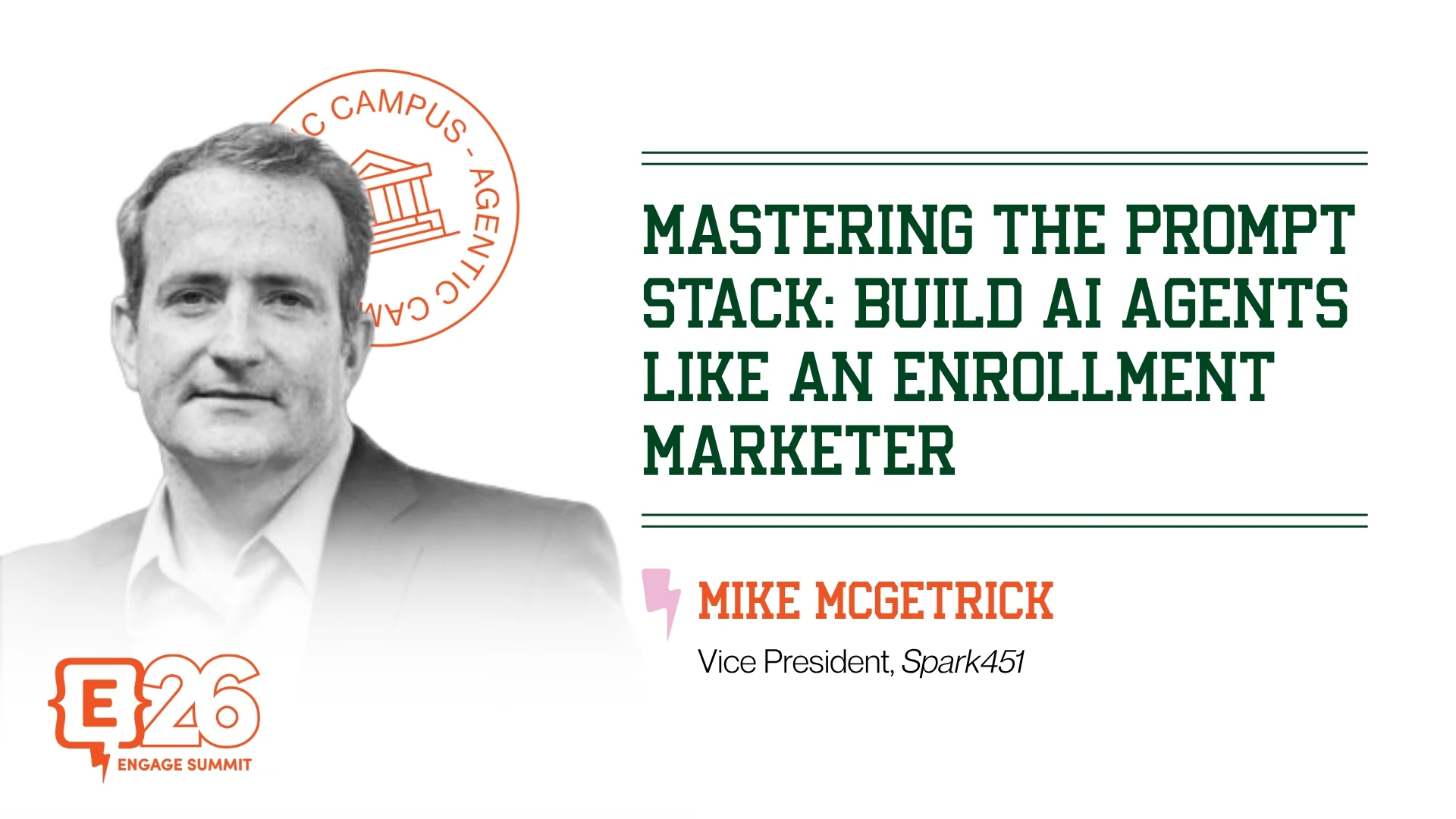
That gap is a prompting problem, not a technology problem. And it is one that Mike McGetrick, Vice President at Spark451, and Ed Flaherty, Manager of CRM and Data Services at Spark451, spent their Engage Summit 2026 session closing.
Spark451 is an enrollment marketing services, strategy, and technology company and a close partner to Element451. Their team works across multiple Element451 instances, building and refining Bolt agents for partner institutions daily. The framework they shared in Charlotte — what they call the Prompt Stack — is how they approach every agent build, and it is designed specifically for people who think like enrollment marketers, not engineers.
The full session is available on-demand as part of Engage Digital Summit 2026, alongside 50+ additional sessions.
AI Can Make Messages. Enrollment Professionals Make Connections.
The thesis behind the session is worth stating plainly: AI is not your enrollment strategy. It is your execution layer. The knowledge, empathy, and institutional context that makes enrollment communication effective cannot be outsourced to an agent. It has to be built into the agent by someone who understands what good enrollment communication looks like.
Mike opened with a frame that grounds the whole approach. Most people who prompt AI are asking for outputs, not outcomes. "Write me an email" is a prompt for an output. "Write a message for a first-generation inquiry student who is three weeks out from our application deadline, has visited campus once, and has not responded to our last two touchpoints — and prioritize reducing anxiety about the application process before driving to action" is a prompt for an outcome.
The gap between those two prompts is the gap between a generic agent and one that actually converts.
The Prompt Stack: What It Is and Why It Works
The Prompt Stack is a structured approach to building Bolt agent prompts that maps directly to how enrollment marketers already think. Rather than describing what you want an agent to say, it asks you to define the full context around who the student is, what they need, and what a meaningful next step looks like for them at this specific moment.
The framework is built around six layers, drawn from the visual prompting techniques Mike teaches in his Generative AI course at Brooklyn College. Just as an artist doesn't guess at composition, lighting, and mood — they decide them intentionally — an enrollment marketer shouldn't let an agent guess at tone, empathy, or call to action. Each variable is a deliberate choice.
Subject — Who is this student? Not just their demographic profile, but their moment. Are they a first-generation senior who just submitted an inquiry? A transfer student who has visited campus but hasn't applied?
Perspective — From what vantage point is the agent communicating? A warm, peer-like voice for a prospective student in early exploration feels different than a clear, direct voice for a student with an incomplete application and a deadline approaching.
Composition — How is the message structured? What comes first — empathy, value, or a call to action? The order matters as much as the content.
Lighting — What is the emotional tone? Encouraging? Urgent? Reassuring? This is not about adding adjectives. It is about deciding intentionally how the message should feel.
Color and Mood — What brand values and institutional voice run through the communication? Every message is an expression of the institution's identity, not just a task completion.
Artistic Style — What does success look like for this specific interaction? Not just "get them to apply" but the specific next step that makes sense for where this student is right now.
Building the Agent: Three Layers Before You Write a Single Prompt
Ed walked through the practical side of turning the Prompt Stack into a working Bolt agent, starting with a point that many teams skip entirely: before you write a prompt, you need a foundation.
The knowledge hub is not optional. It is the source of truth for every response the agent produces. If the knowledge hub contains outdated program pages, expired deadlines, or inconsistent institutional voice, the agent will reproduce all of it faithfully. Ed's team has seen agents surface past application deadlines in student conversations because that was the best the agent could find on the institution's website. The knowledge hub is also the primary tool for brand control — removing or replacing imperfect content sources, enforcing institutional voice, and preventing hallucinations before they reach a student.
Once the knowledge foundation is solid, the Prompt Stack comes in three layers before execution.
Human Insight Layer — Who is in this segment? What is their moment and their mindset? A traditional-age senior in early inquiry is in a completely different place than a transfer student who has visited campus twice and still hasn't applied. The agent needs to know that difference — and it only knows it if you tell it.
Strategy Layer — What is the outcome, not just the task? The goal is not "get them to start an application." The goal is to guide a student through a specific experience that reflects the institution's values and moves them meaningfully forward. That means setting multiple actions within the job, defining value propositions, and building in the institutional brand voice that makes a message feel like it came from the institution and not a content generator.
Execution Layer — How does the message actually get delivered? Channel matters. Tone matters. Frequency matters. An agent that doesn't know not to send a text message to a student who just received an email two hours ago is going to erode trust fast. This layer defines the specific instructions that keep the agent operating the way a thoughtful enrollment professional would.
Generic vs. Prompt Stack: What the Difference Looks Like
Ed showed a side-by-side comparison of two Bolt job outputs during the session. The first was generated by the Bolt Job Creator with a simple brief: encourage RFI leads to start their application. Polite. Direct. Informative. The scroll bar was short.
The second was built using the Prompt Stack. It introduces and connects. It shares value and meets the student's mindset. It demystifies the process, differentiates the institution from others the student is considering, adds clear value propositions, and drives to action in a way that invites a response. The scroll bar was considerably longer.
The output from the Prompt Stack version appeals to the student's mindset, carries a tone of transparency and authenticity, provides clear and familiar next steps, and achieves something the generic version cannot: it feels personal.
That is the goal. Not to hide the fact that an AI agent is sending the message — Ed and Mike are clear that agents should be identified as such — but to make the message feel authentic enough that a Gen Z student receiving it actually engages with it rather than deleting it.
This Is Not a Set-It-and-Forget-It Situation
One of the most useful things Ed said in the session is that building a good prompt is the beginning of the work, not the end of it. Once a Bolt agent is live, it requires the same ongoing care and attention that a well-run nurture campaign does.
Engagement signals need to be monitored holistically. A student who doesn't respond to an agent message may still visit the website the next day or Google the institution a week later. Response rates alone don't tell the full story. High-performing jobs need to be identified, low-performing ones analyzed for drop-off patterns, and prompts refined as deadlines shift and enrollment cycles evolve.
The institutions that will get the most from these tools are not the ones that deploy AI and move on. They are the ones that treat their Bolt agents the way they would treat a new enrollment counselor: with training, feedback, and continuous coaching.
"It's not, 'oh, we are using AI, we've deployed AI.' It's about embedding this as part of your engagement system. You really take the tool and you train it like you would a human. You give it the compassion and the empathy."
Watch the Full Session
This session is available on-demand as part of Engage Digital Summit 2026. Watch it alongside 50+ additional sessions.
About Element451
Boost enrollment, improve engagement, and support students with an AI-driven CRM and agent platform built for higher ed. Element451 makes personalization scalable and success repeatable.
Categories
New Blog Posts


The Definitive Guide
AI in Higher Education
Bridge the gap between the latest tech advancements and your institution's success.
Useful Links

Talk With Us
Element451 is an AI-driven CRM and AI agent platform for higher education. Our friendly experts are here to help you explore how Element451 can improve outcomes for your school and students.
Get a Demo